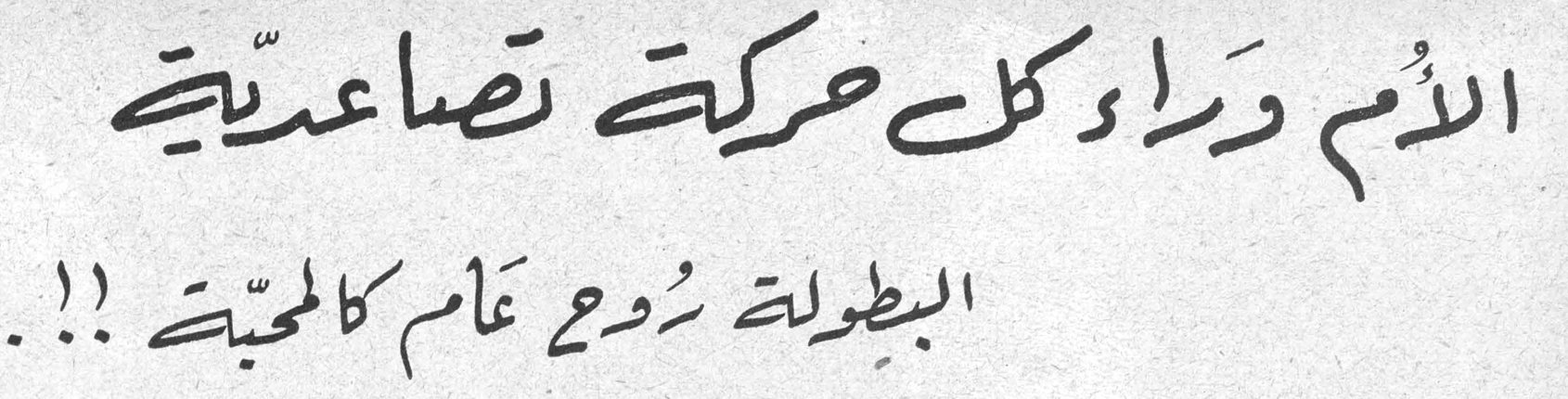
When al-Khansa lost her brother Sakhr — she is a poetess well known in the history of ancient Arabic literature — her nerves gave way, and she burst out in grief for the dear departed. Indeed, we find that she vowed herself thereafter to that grief, and put on the mourning garb of the bereaved, refusing all consolation for the loss of one who was to her "like a mountain with a fire at its summit"!
This was al-Khansa before Islam — that is, before the Arab, man and woman alike, had a higher ideal, a good creed, and a human message. But when al-Khansa embraced Islam, and was set free from the servitudes of the pagan Jahiliyya, and her thought, her mind, and her heart were liberated — she found in her bosom four young men who were an ornament among men. Those were the sons of al-Khansa, who volunteered for the struggle in the cause of that message, in the cause of God — and they were slain as martyrs, among those who fell martyred at the battle of "Badr." Do you know what al-Khansa said when the news of them reached her? She said, without weeping or wailing: "Praise be to God, who has honored me by their death; and I hope that He will gather me with them in the resting place of His mercy!"
This spirit that shines forth in "the Mother" at the fall of her sons — this spirit that al-Khansa lacked before, at the fall of her brother — is the spirit that many men and many women among us lack; it is
the spirit we lost long ago, and with it we lost many of the foundations of a proud and noble life.
What, then, happened in al-Khansa's soul, that she was transformed from a "woman" into a "Mother," from a weak female into a heroic messenger? In this very question its answer is contained. Al-Khansa was created anew from the moment she was steeped in the spirit of heroism.
In ancient history, as in modern, there are many examples known to those acquainted with that spirit. Among them the example of King Albert of Belgium — in the First World War — when the Germans summoned him to surrender, or else they would sweep over his country entirely. The hero-king's answer — weak as he was, with his small army, before the mighty German armies — was an answer brimming with heroism, for it came as the answer of a king who believed in his people's and his country's right to freedom and to life. He said to them: "You shall not pass... except over my body!"
Heroism has many colors and forms
This heroism in war has its counterparts, heroisms in the other spheres of life. The scholar who dedicates himself to learning; the discoverer who devotes his life to research, widening the horizons of human knowledge; the mother who wears herself away to present the homeland with worthy sons and daughters; the teacher who melts away to light the path of learners;
the writer who wastes away to guide his readers, women and men — all of these, and many others besides, are heroes deserving the nation's thanks and history's glorification. For heroism, like love, is a universal spirit: it presides over work well done, over sincere effort, over disinterested striving, just as love presides over every dealing among people, whether individuals or groups. And there is nothing in the world a human being can do that is nobler, greater, or more enduring than a heroic deed steeped in love, as perfume steeps the splendid flower.
The face of heroism
And do not suppose that heroism is the preserve of the great... Rather, when it comes from others than they, it appears greater and grander still. Otherwise, what merit has the sea, if it favors the dry land with the gift of rain clouds and the dew of dawn? Or the sun, if it favors it in turn by being the one that warms the water and the air, raising the vapor and stirring the wind?
Heroism, then, is not the preserve of the great, though they are worthier than others to give the good example and the righteous model. Every one of us can be a hero — or a heroine — whenever he wills it, or she wills it. Sacrifice alone is the measure by which deeds are measured: whatever deed is done in the cause of good, its doer is a hero.
Sacrifice of what the individual can give: he who sacrifices his