In the previous article we treated the two directions in which music moved — the church direction and the popular direction — and the development in composition and notation, mentioning the most important new musical forms. As for the great figures of this period, they are Martin Luther the Reformer, Lassus, and Palestrina, and we shall speak of each of them briefly.
Martin Luther (1483–1546) He is the pivot of the movement of reform in the Church. One of the first things he took upon himself to reform, after his separation from the Catholic Church, was the setting of a music proper to the new church. Luther had sensed the German people's love of music and singing, so he worked to compose hymns in whose chanting all the worshippers would join; and in order to accomplish this he had first to rid himself of the Catholic "Mass" and replace it with a new form — and this was the Chorale. As for the new hymns, some of them were adaptations of the Gregorian modes and of popular melodies, while others were original and new, composed by Luther himself.
His importance: Martin Luther was the first to declare that the Devil must not monopolize the beautiful tunes. On this faith he lived and died. As for the influence of the chorale, or religious hymn, it was slight with respect to music in general; its effect was
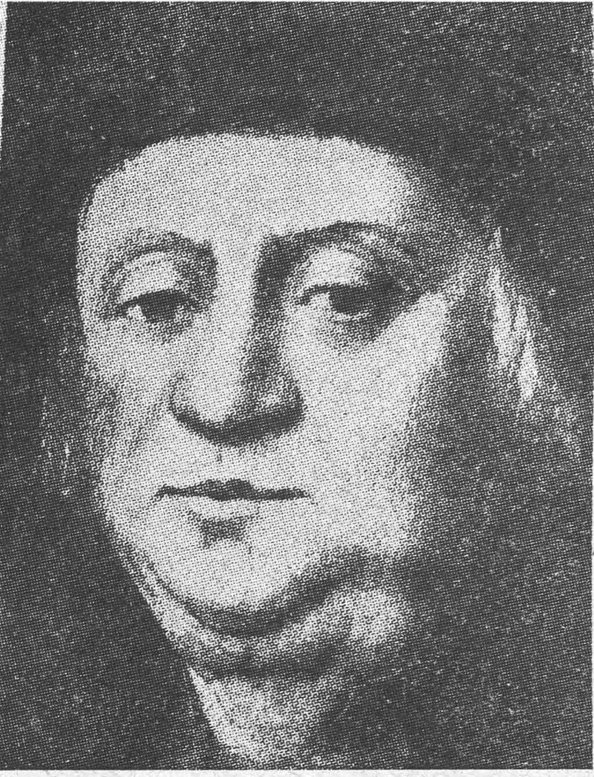
Martin Luther
confined to the music of the first quarter of the eighteenth century.
Lassus (1532–1594): Belgian in origin, he had a beautiful, enchanting voice, which led to his being kidnapped three times from school so that he might join in the singing with one of the choirs. After long wandering in Italy, he settled for a time in Rome, then returned to "Antwerp," whence he was summoned by the prince of "Bavaria" in Germany to lead the court choir in Munich. Lassus composed many pieces, sacred and popular, among them a great number of motets. It is related that on one winter's day the prince of Bavaria resolved to hold a great musical procession in the streets of Munich, when fierce
winds blew up and the sky grew overcast with clouds; so the prince ordered the procession held inside the spacious hall of the church. But no sooner had the choir begun to sing a motet composed by Lassus than the clouds dispersed, the sun came out, and the winds died down — and the celebration was held in the streets. The people of Munich regarded this occurrence as a marvel.
His importance: Lassus is the representative of the Flemish school of music, and he stands for the summit — reached after a development that took a long time — in the composition of the religious hymn that relies on pure musical beauty and on the desire to express human feelings.
Palestrina (1525–1594) An Italian who spent most of the years of his life in the palaces of the popes and in the service of the Church. The challenge of the movement of reform led by Luther produced a violent reaction in the circles of the papal court, and they set about reforming what had grown corrupt in rules, rites, and customs. The task of reforming Catholic church music was entrusted to Palestrina, who rendered signal services that revived the Catholic Mass; he also wrote numerous compositions for the Church. As for the reward Palestrina received for his good work, it was that he was buried in the burial place of Saint Peter's in the Vatican, and on