Lebanese folklore comes to the fore for the first time in a grand setting
The past has more than the cold pages of history... The past has keys of gold in small pockets and in shy, obscure mouths... The past has the tableaux of folklore... and most of ours are hidden things, shrouded by an indifferent aversion and an ignorant neglect — God forgive me!
In our popular heritage are glimpses, winks, and signs that must endure, so that there may endure what is massed behind them of spiritual edifices for our lives and our beings.
To return to folklore is guidance... and today I carry glad tidings that remain joyous even once they are known...
The mantle of Lebanese popular art will ripple at the Baalbek Festivals in a new weave in which melody, song, and acted dance become brothers!...
And the truth must be told... the Baalbek Festivals are, all of them, the strides of a giant that will not turn back. This is what was suggested to me by my conversation with Ustad Samir al-Suqi, secretary of the festival committee... A project like this one, in our country, must wrest success by main force in the face of difficulties and obstacles known to everyone who has cut a road and opened a passage. And yet not everything wished for has been attained and realized. There are homeless projects and a confused, anxious budget... a result that gives no pain!!
Will the sun of Baalbek return, I wonder? Will there resound among the columns of its citadel a present greater than the past and its tales — tales inspiration had almost grown weary of and weaned itself from?
I behold the citadel of Baalbek,
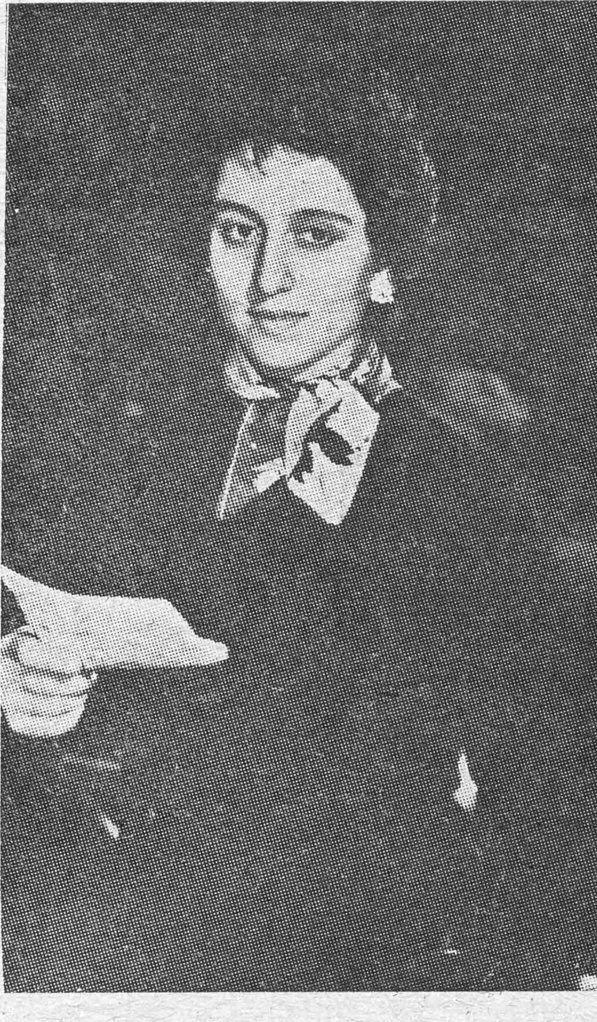
Fairuz's angelic voice will rise in the temples of Baalbek!
in my wishing, as a temple for newborn art... for beauty ever renewed... for the spacious, radiant image... for the resonant, well-stocked word!...
And the little tale begins today with a count of the names of the organizers of the popular-art performances at the Baalbek Festivals.
The committee is composed of Mrs. Zalfa Chamoun — whose
persevering concern with all that is authentically popular was the first seedling of the whole project — then Ustad Khalil Hibri, the wives of Messrs. Fouad Salam and Hasan Daouk, and Ustad Najib Hankash.
The virgin work is being carried out by Mr. Marwan Jarrar and his wife, Mrs. Wadia — the two of them are training the troupe of dancers — then the two Rahbanis and Fairuz, who need no introduction, and Ustad Sabri Sharif, the discerning director.
I listened to Mrs. Jarrar speak of her work, and in her words I tasted a surging faith backed by specialization from London and training in Moscow.
There is folk dance in Lebanon, said Mrs. Jarrar, but it moves only a few feet in the scattered villages. Like all folk dance it seems, at a hurried glance, a fall of feet whose regularity is monotony and whose art is naivety. As for the Lebanese dabke, its limbs are scattered here and there — so why not gather them all together? Why not make it evolve within a frame of conservative renewal?
Is not the Lebanese dabke a scene that paints resolve, steadfastness, union, and pride? You speak truly, Mrs. Jarrar — but few have seen that, because all they pick up from it is the regular sound of pliant feet striking the earth hard once... let us strike it softly twice!!
The "Jarrar duo" is today training a troupe of volunteer