opening of the twentieth century... Around this woman are three men who never leave her side. The first is the husband, "De Ciz," a man of handsome face, well dressed, calm in his movements, who leaves no clear impression of his person upon those who look at him... The second is "Amalric," a man of thirty-five, tall of stature, energetic; in his rapid stride and the tone of his voice are the marks of full manhood. He follows "Ysé" like her shadow, for he loved her before her marriage, and now he sees her for the first time after an absence of ten years and this love flares up in his heart anew... He courts her and waits for her to fall into his arms, for he is a man sure of himself and of the power of his mastery... The third is "Mesa," a man of about the same age, but, unlike his friend, slight of body, confused and bewildered; on his face appear the signs of anxiety, as though he were suffering a violent crisis of the soul, and in his burning eyes are a thousand questions and one... He moves among men as if a stranger to them, for God called him in the flower of his youth and he offered himself to be consecrated a monk in the service of the Most High; but after a short trial he felt that he was not created for the austere life of the monastery, and so he returned to the world once more, perplexed, seeking travel in the hope that it might hold the solution to the riddle of his life... Here he is, at the middle of life, face to face with the woman on the deck of the free, speeding ship in the midst of the ocean, under the scorching blast of the equatorial
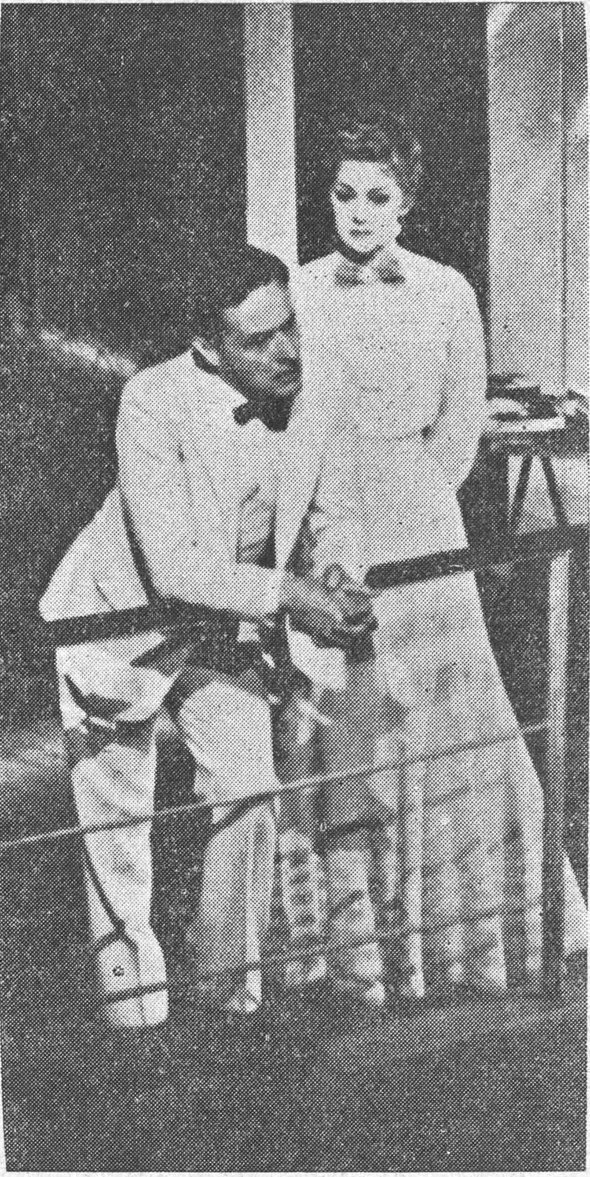
Act One: On the ship's deck: Ysé and Mesa perplexed before their dangerous love
noon... The body has its dominion and its pride, and the heart its insistent beats... And Eve offers the fruit — but the fruit is forbidden, for marriage is sacred...
And "Mesa" the man wrestles in violent conflict between spirit and flesh, and asks his Lord: "Why, O Lord? Why this woman?... Why did she come so late?..."
As for this woman, she is the beautiful "Ysé," the complete female; wife and mother; she is the wondrous creature who carries in the grip of her hand man's salvation and his ruin; she is the tree of good and evil, and she is, beyond all that, the woman who was made for "Mesa"; for between them is a natural harmony, an ease of spirit, and an ember of love blazing in their breasts, all but bursting into a fearful volcano of passion... "Ysé"
was accustomed to toying with the hearts of men, and she seems merry and playful; but no sooner did she feel the glances of "Mesa" pierce her than she trembled in her whole being... She makes light of "Amalric's" love and answers his boldness with a natural hauteur and coquetry, for she is equal to that love — the material, bodily love of a man who gives as much as he demands. But "Mesa"?... "Mesa" is another matter... He is not handsome like her husband, nor strong-armed like Amalric; but in his sharp glances there is an insistent plea for a deep response, a searching for something lost, a question about an obscure riddle... This love is a dangerous secret before which "Ysé" stands perplexed and questioning; she cannot disdain it, yet she feels her need of it. What is to be done?... She begs "Mesa" to keep away from her... — "Mesa"! Tell me that you will not love me... Say to me: Ysé, I will not love you!... — I will not love you... — Say it again, that I may hear it well... — "Ysé"! I will not love you... — Once more... And her glances meet a pained, suppressed gaze with which the words are choked...
Act Two: In "Hong Kong," in China.
"De Ciz" is preparing to travel for commercial business awaiting him in a distant port... "Ysé" feels the danger closing around her, for "Mesa" is in "Hong Kong" and wishes to meet her, so she begs her husband not to leave her alone... But the journey is necessary, there is no avoiding it... So Ysé tries by every means to persuade him to stay near her...