
Gibran entered the drawing hall of the institute carrying under his arm his portfolio of papers and pencils, and cast a long contemplative glance at the "model" — a naked young woman reclining on the platform, on whom the marks of boredom and weariness showed. A sign of displeasure appeared on him; he searched for me with his eyes, then drew near me and whispered in my ear: — This poor creature inspires pity in me... I have no desire to draw... my soul tightens to the point of suffocation in this glum, dreary atmosphere... I would rather stroll along the riverside to watch the terror of the flood.
We left the papers and pencils in the keeping of Madame Catherina... who inquired anxiously whether the "model" had failed to please us — and a lovely stroll was ours...
Ten minutes on foot and we were on the Quai Voltaire — we passed before his statue, and Gibran said: — That is your uncle, the "Patriarch of Ferney"... greet him... I said: — Go up yourself and touch the hem of his garment, that the grace of laughter may descend upon you... and stop standing there scowling... wearing your face inside out!!
We stood a while watching the waters pour from beneath the bridges, boiling and seething and overflowing the edges of the quays — a frightening, magnificent spectacle of the powers of nature and her might... made the more terrible by the dark of night and the faint lights glittering and dancing on the face of the water, defying the black, angry waves... Gibran was the one who began to speak, though I had thought him sunk in contemplation: — Miss Olga visited me this afternoon and told me that the damp from
the rising of the river's water has begun to seep into the place where she practices the piano. She asked my leave to move it to my place... and I think that impossible... the entrance is narrow... and then I receive my friends and acquaintances, mostly, every afternoon... In my view your place is more suitable... its entrance gives onto the street,
and you are away from it all afternoon. And Miss Olga, as you know, is gentle and well-bred and will cause you no annoyance... I was not wrong when I told you she is honorable and of lofty character... My admiration for her has been increased by her deep culture. She speaks English and German besides French and Russian...
And she talked to me of the Russian writer "Tolstoy" and the German philosopher "Nietzsche,"
and ventured such opinions and comments as raised my esteem for her... Ah, Youssef! How great is the difference between one woman and another — as if women were not all of a single species!"
We had drawn near the cathedral of "Notre-Dame," so we stood a little in the square, contemplating the lines of the entrance... and of the façade...
The utmost magnificence! I said to Gibran: — This sumptuous temple was raised in honor of a "daughter of the country," our Lady Mary... And a young man and a girl passed close by us: hand in hand, talking in whispers and laughing in happiness and rapture... Gibran, having forgotten our Lady Mary, said: — What might those two be saying?... Trifles, no doubt... a passage from the eternal hymn of love... a prelude to love's intoxications... And when feeling cools, after this blazing fire, the quarrel begins, and parting follows it... And perhaps the fruit of this love will be a new child, who feeds and grows, to grow up and act the eternal play over again... a little wave on the surface of the ocean of existence...
Our walk had brought us to the streets of old Paris behind the church of Saint "Julian the Poor," and Gibran asked me: — What did this saint do, I wonder? I answered him: — Do you mean Julian the Poor?... I do not know exactly what he did, except that he died a martyr... I know approximately what "Julian the Heretic," the Roman emperor, did... — You incline to heretics more than to
saints. That I have come to understand! Come, tell us what your friend the heretic did. — First, he loved living in Paris — he was, like us, a man of taste! Then he tried to mend the error of his uncle the Emperor Constantine and restore to the gods of Olympus their
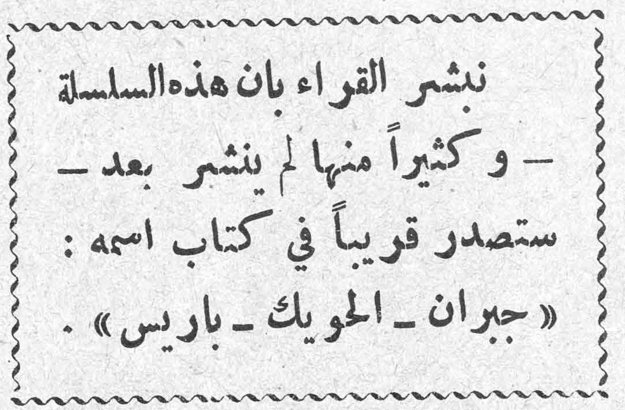
We bring our readers the glad news that this series — much of it not yet published — will shortly appear in a book entitled: "Gibran — Howayek — Paris."