as possible...
Setting to work: Widad answered the mother's appeal, and found with her four little ones — a nucleus for beginning the work — but where was she to shelter this nucleus?
Here appears the name of Ustad Sami Salibi, owner of the Institute of Music and Drawing in Ras Beirut — that humane man who encouraged Widad, opened the doors of his institute to her, and promised to assist her with every means at his disposal... and he kept his promise... He took upon himself to train the blind in singing and to play for them himself, as those who attended the artistic performance at Beirut College for Women saw and heard... all of it for the sake of God, without any recompense...
In speaking of those who encouraged her and took her by the hand, Widad remembers with abundant gratitude Mr. Usama Dimyani... and naturally she does not forget the Dutch expert Mr. Andevik, with whom she will cooperate this coming autumn to train women
and men teachers to help her in teaching the deaf-mutes.
At the school for the blind: Widad attaches importance to the Society's promises to open the school for the blind at al-Warwar this coming October. This modern school is a boarding school, and will accept boys and girls whose ages range between five and twenty years. But if circumstances should prove contrary — God forbid — and the school not open, Widad will proceed without delay to rent a house for this purpose. Fundamentally she prefers the service and teaching of the blind; but if no one can be found to teach the deaf-mutes, then the energetic pioneer will enlist herself...
The difference between the blind and the deaf-mutes: Widad affirms that there is a great difference between the blind person and the deaf-mute — the first is keenly sensitive and more responsive to his surroundings than the second. The deaf-mute does not hear sound, and so he is dull and little responsive, and work with him is more laborious; his instruction is therefore very slow...
The method of teaching the blind: Widad explained to us briefly the method of teaching the blind — it is by training his senses: hearing, taste, and touch, to take the place of sight. For example, the teacher throws something — a book or a pencil — on the floor, and asks him to name "the thing" and to search out its place — or she asks him to identify objects by way of smelling or tasting them. In teaching the blind to read they follow the "Braille" method, with its raised letters, which the blind person feels with his sensitive fingertips — and these books are imported from England and from Jerusalem and Cairo — for there are as yet no presses for raised letters in Lebanon.
The method of teaching the deaf-mute: The teaching of the
latter relies on speaking before the mirror, by way of feeling the vibrations of sound with the fingertips on the throat and in the mouth and the nose... The ha, the ayn, and the kaf come out of the throat; the ba, the ta, and the mim from the front of the mouth; the ha with the panting whose vapor they see on the windowpane; and the nun from the nose — and every letter has its own art and its own point of issue, which demands endurance and patience... and love!
The afternoon is set aside for learning handicrafts, as the foundation of a trade they may follow in the future — and what these physically handicapped are most encouraged to take up is carpentry.
The final aim: These unfortunates, Widad affirms in closing, are innocent creatures on whom nature has dealt harshly, depriving them of the blessing of the senses, so that they were flung into the streets and the alleys if they were poor and wretched, or shrank in upon themselves within their own four walls if they were well-off. Our duty — we, the sound of body — toward them, and my aim behind this work, is to help these creatures as far as possible toward normal life and honorable work, and toward taking their rightful place in society, without being a burden on anyone, or an object of anyone's pity... We stand behind their material independence and their dignified living...
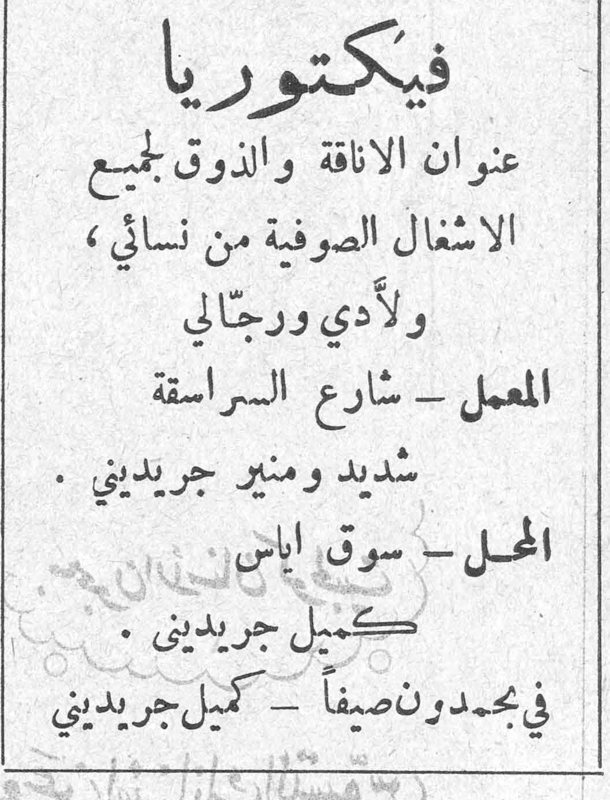

Victoria
The very name of elegance and taste for all woolen work — ladies', children's, and men's
The workshop — Sursock Street
Shadid and Mounir Jureidini.
The shop — Souk Ayyas
Camille Jureidini.
In Bhamdoun in summer — Camille Jureidini
Sultan Soap
Sultan