—7—
After the last world war the world turned toward international groupings of every kind — political and cultural institutions of all sorts. The United Nations and its many branches express this tendency in the modern civilized world, and man's hope of reaching the solution of his problems by way of peace and understanding instead of wars and disputes. And since culture is the soul of civilization and the wellspring from which it drinks, eyes turned toward the international cultural institutions, that they might be an instrument of solidarity and rapprochement... And who knows? Perhaps what was impossible for politics and its people may become possible through cultural and spiritual exchange.
The "Theater of the Nations" in Paris is trying to contribute to this bold experiment. It invites the masters of the theatrical art from all parts of the world, each to come with his troupe, his language, and his own methods, and offer his wares in the Sarah Bernhardt hall during four months of every year. It was founded on June 29, 1955, by decision of twenty-three states belonging to the "International Theatre Institute," with the approval of the French government and the municipal council of Paris.
The theater houses within its walls various international institutions, among them: the International Association of Theater Critics; the International Association of Theater Professionals; and the Club of the Theater of the Nations, which tries to bring together individuals interested in theatrical activity and believing in its cultural mission, setting before them the theories of the modern directors and the various problems of the theater, in lectures given by the great critics and in discussions in which the public, the actors, and the directors take part together...
In the latest bulletin issued by the theater's administration on its activity and its program for the past season we find the following figures:
States taking part in performances: 11 Languages used: 8 Plays: 11 Ballet: 9 Opera: 7
Among these states are England, Norway, Russia,
Germany, Japan, Morocco, China, and France; each came with its own troupe, expressing itself in its national language, its particular style, and its novel apparatus of staging.
That we may grasp the importance of this theatrical display, let us mention some of the famous plays whose staging has left a tangible mark on the world of literary criticism and on the modern artistic tendency. Among the most important of them is Shakespeare's "Titus Andronicus," presented by the Shakespeare Memorial Theatre company, directed by Peter Brook and acted by Laurence Olivier and Vivien Leigh. The troupe performed it in English, and Jean-Louis Barrault (J. L. Barrault) had earlier read its French translation over the Paris radio, to ease the theater's task and spread the play among a public that does not know the English original. It met with dazzling success, although it is unknown to
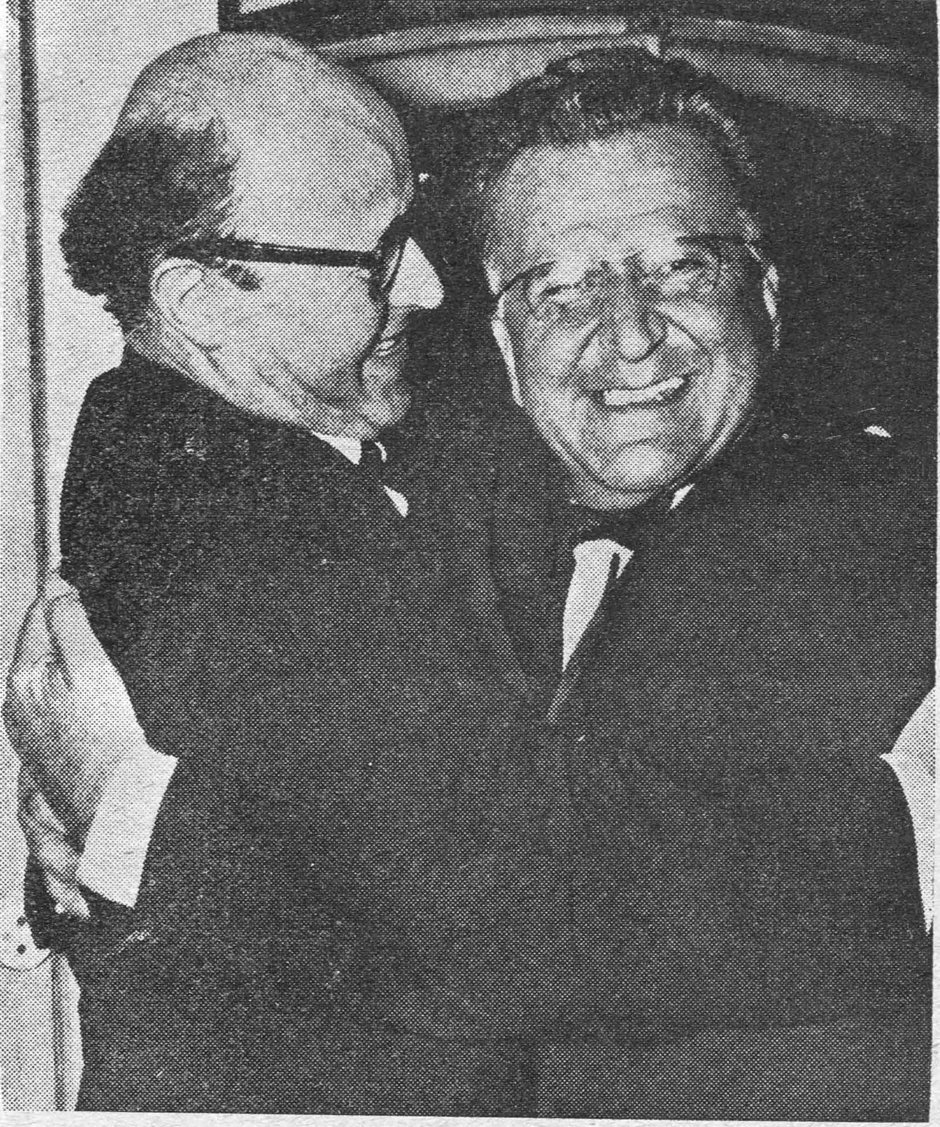
A. M. Julien, the French director of the theater, and Hans Schalla, director of the German Bochum theater, meet at the "Theater of the Nations" in Paris.