most lovers of Shakespeare, since men of letters and historians count it among the least important of his plays and the most tangled: the author wrote it in his first years of production, when his art was still in its childhood, feeling its way under the influence of the Elizabethan stage of that day... Its success at the Theater of the Nations is due, of course, to the collaboration of Laurence Olivier and Peter Brook in acting and direction. Brook took charge of the direction, the stage décor, and the music — an arduous task, each part of which is usually assigned to a particular person. The reason is that Brook believes the play to be a complete unity, whose staging must be undertaken by one man who directs the actors, decides the form of the production, and composes the music at the same time. And the director must not be bound by the surface text of the play; he must go beyond it to grasp the poet's message, so as to uncover his deep dream and present it, clear and crystallized, to the public...
The German theater presented three plays by the well-known German author Bertolt Brecht, among them the famous "Mutter Courage"; also the play "Requiem for a Nun," of which we spoke in a previous issue, by the American writer Faulkner; and the play "The Devil and God" by the French writer Jean-Paul Sartre. Each of the German directors, Erwin Piscator and Hans Schalla, set forth his views on theatrical direction and on the use of colors and lights to express the author's message. Last May I attended a discussion at the "Club of the Theater of the Nations" turning on the lighting used in Brecht's "Opéra de Quat' Sous," in which the director Hans Schalla, members of the administration of the Theater of
the Nations, some of the actors and critics, and the public took part. The talk went on in both German and French; the press took up these views, and from them came valuable studies of the methods of theatrical art in France and abroad. One of the subjects the critics broached was the comparison between the staging of Sartre's "The Devil and God" by the German troupe of the "Bochum" theater under Schalla's direction, and the staging of the same play by the "Antoine" theater in 1950. For there is no doubt that director and actor exert a great influence upon a play: the same piece may appear wholly different if we see it on this stage or that, staged by different persons — as happened with Faulkner's play, "Requiem for a Nun," which the German troupe rendered in a manner entirely unlike Albert Camus's production in French. Opinions clashed as to which was the truer expression of the author's spirit and message, and the critics differed over the style of direction and the stage décor, and so on through all the divergences of professional and artistic method.
From this brief glance it appears that the "Theater of the Nations" is still taking its first steps, and
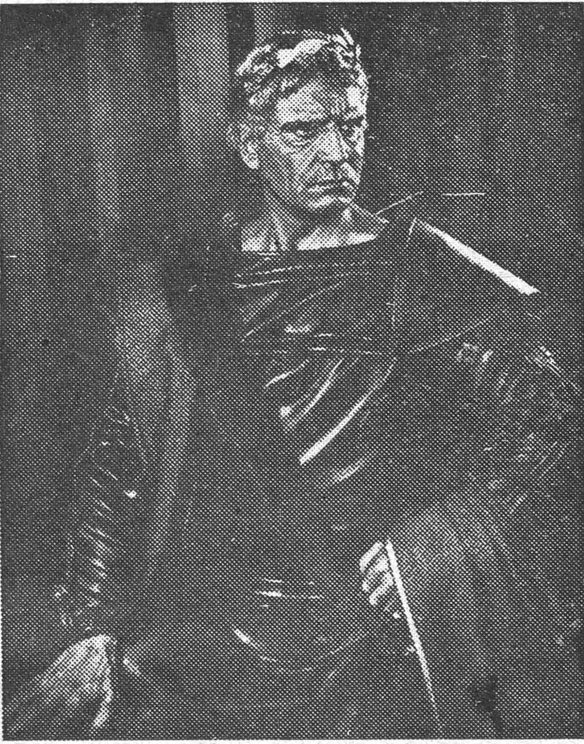
Laurence Olivier in the role of Titus Andronicus, by Shakespeare
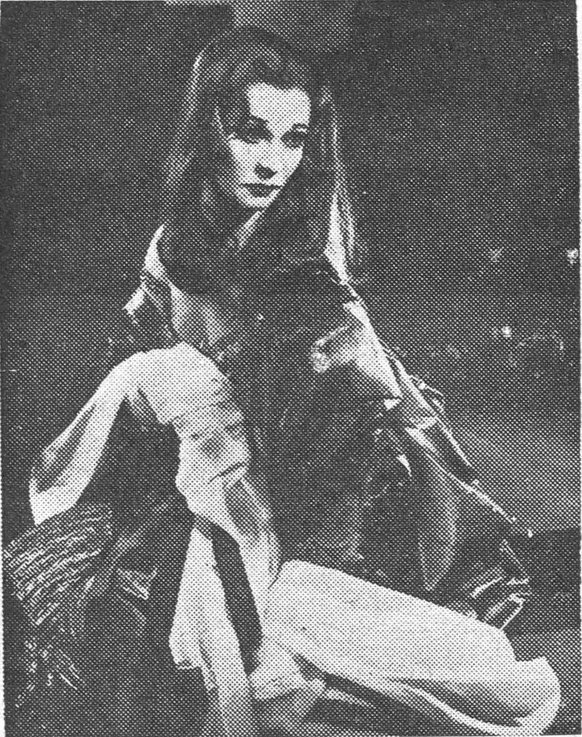
Vivien Leigh in the role of "Lavinia" from Titus Andronicus
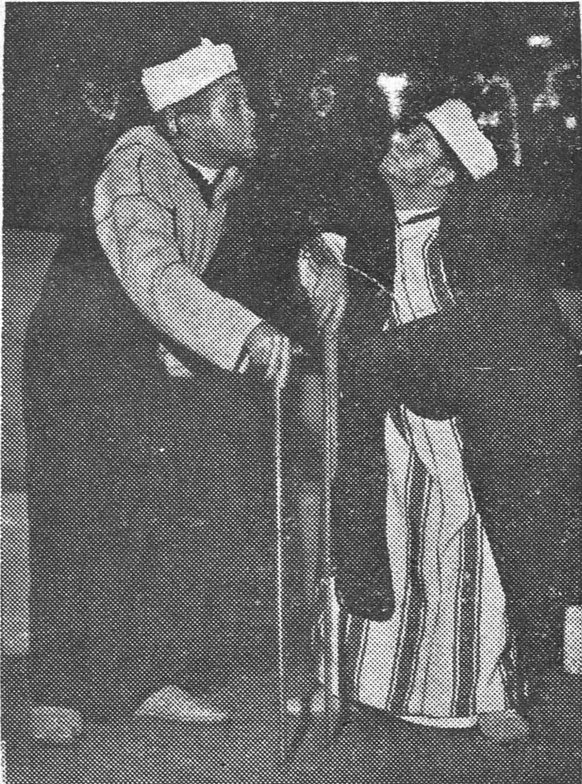
The Moroccan acting troupe presents "The Wiles of Juha" in Arabic
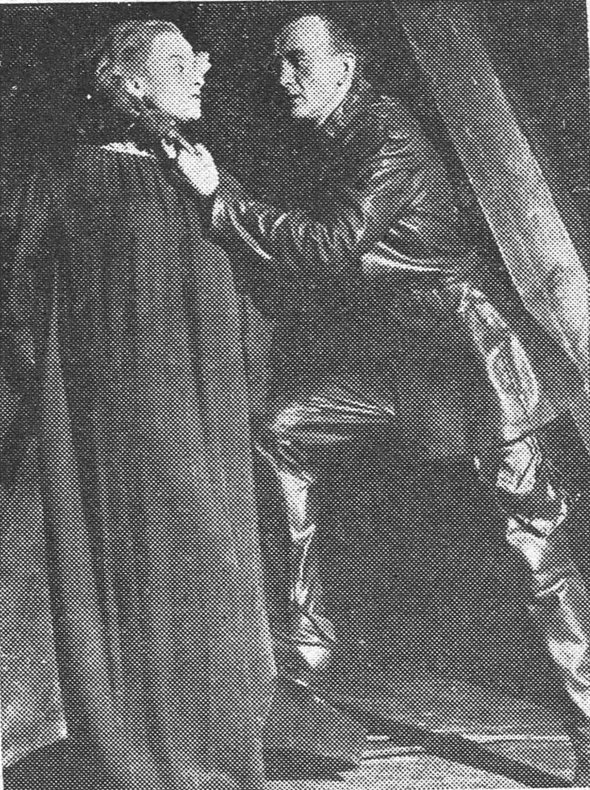
Hans Mayer and Rosel Schäfer in Sartre's play The Devil and God