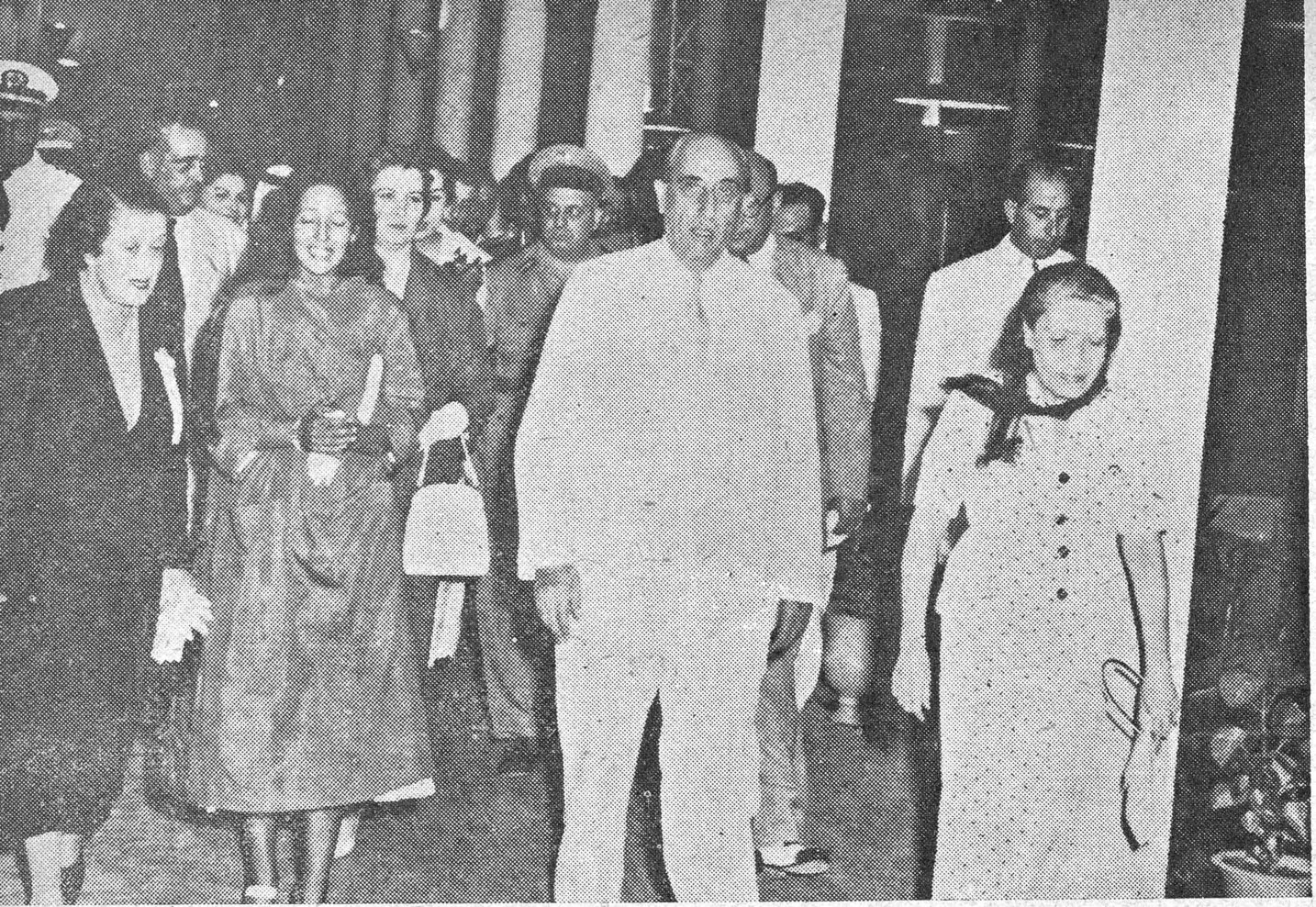
His Excellency President Shukri al-Quwatli at the opening of the conference; on his right the Emira Aisha, then Miss Ibtihaj Kaddoura, the former president of the Union, and on his left Mrs. Adila al-Jazairi, the new president
Women of seven states met in Damascus between the ninth and the fifteenth of last September. The participating states were Lebanon, Syria, Iraq, Egypt, Sudan, Morocco, and Palestine...
The Fourth Conference is another step by which the Arab woman plants her foot on the ladder of advancement and progress, and assures the world that she will not retreat and that her constructive revolution marches on with the days.
The first day of the conference was given to introductions, and eyes searched every corner for a new face, or for another face met at previous conferences. The opening ceremony, under the patronage of His Excellency the President of the Syrian Republic, was held in the theater of the Exhibition, and in it the presidents of the seven delegations spoke of the aims of the conference, its history, and the messages their governments had sent to the sister countries. There followed the days of meetings and lectures, all of which turned on the subjects we feel in our society and the problems that beset this society, among them: "The Role of Woman in Forming Arab Nationalism," "Protection of the Family," "Care of Vagrant Childhood," "Protection of Motherhood and Childhood," "The Family in Iraq," "Palestine Speaks," "Compulsory Education," and "The Role of Woman in the Countryside"...
Each of the lectures was followed by a discussion period, in which the listeners could put questions and debate the subject. What may be held against the conference in this respect is the shortness of the discussion periods relative to the lectures... And there is another criticism we hope the women of the Union will take into consideration, namely the cramming of the lectures, so that the audience would listen to three speakers in a single session, without any change or variety in between. Our ladies may ask here about this coloring or variety we have in mind; accordingly we propose introducing some artistic material and
original literary subjects — story, prose, and poetry — for thereby the field is opened to the gifted among our sisters in the Arab countries, and at the same time it lends the meetings color and richness... and acquaints everyone with the creative subjects that spring from the minds of the talented, whose number is not small.
And I ask here, as many of those who attended the conference asked: Where are the young? Where are the university women and the women of specialization? Why does the modern girl not help in the affairs of her society? Is it negligence on her part and a want of any feeling of responsibility? Or is it that the associations open no field for these women to work — a thing which, though we ask about it, we do not for a moment believe exists?.. We need, then, the energy of the young women who will take up the torch of the renaissance after its pioneers, the women who spent their lives to kindle it.
And when we speak of the discussion following the lectures, we mean that positive weighing of opinions so as to reach an effective, constructive result; and I cannot but mention that the debate would often grow lively and develop until it strayed from the subject and moved in another direction — and if this indicates anything, it indicates a lack of intellectual harmony, and of that complete attention which follows all that is said... And if we criticize this aspect, we do not deny the complete sincerity that lay behind every word spoken at the conference!