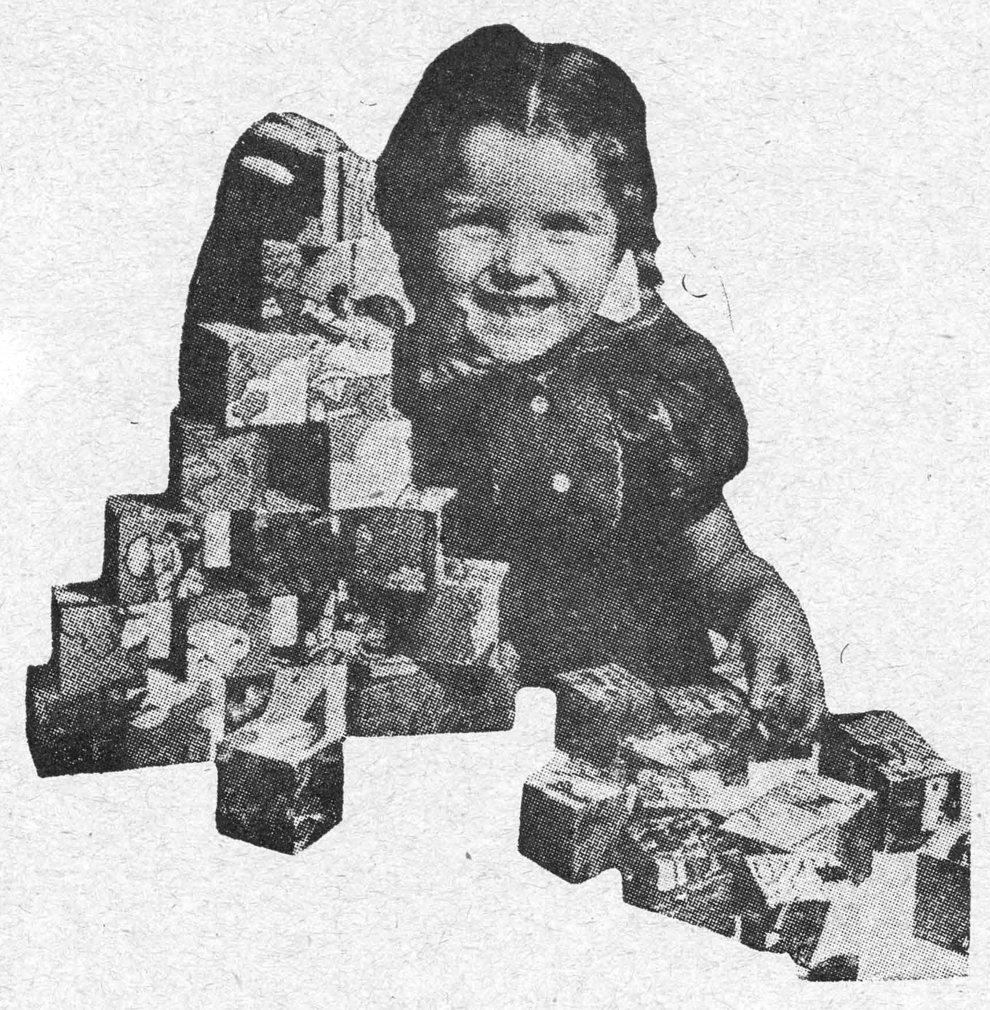
Place in their hands the toys that awaken and strengthen their senses
The psychologist William Stern said of a little girl not yet past her fourth year: "Play takes possession of Hilda exactly as inspiration takes possession of the poet at the hour when the idea crystallizes and its birth draws near." There is no exaggeration whatever in this saying, for play in the age of childhood is not, as occurs to the minds of many parents, merely for amusement, but for discovering the secrets of the outside world, which is still unknown — so that this world becomes a touchstone for their powers and their skill in confronting it, whetting their minds and engaging their imagination. The toy that a mother buys for her child is nothing but an instrument that allows him to measure himself against what surrounds him, increasing his experience and teaching him mastery over things as they are in their natural size. Its value lies not in its price but in how far it suits the child's age: what suits him in the first year, for example, differs entirely from what suits him in the fourth or the sixth.
After the fifth month the infant becomes able to grasp things, and the sense of touch becomes his means of contact with what is around him. At such an age, therefore, the mother must strengthen this sense with toys of rubber, for instance, or with cubes of plastic that he can feel without their hurting him — these latter allow him to become acquainted with the shapes and forms of things. The sense of sight, for its part, is exercised by means of the balls and toys that are hung above the crib in loud colors such as red, yellow, and orange, since the child at this early age is unable to distinguish any but this kind of colors — contrary to what parents believe
when they resort to pale colors like pink and sky blue.
At the beginning of the second year the journeys around the room begin: the child takes his first tottering steps, and the falls follow them. In this stage the mother must help her child in his arduous effort by strengthening the muscles of his back and legs, letting him try to climb the steps of the stairs. The choice of toys at this age rests on the basis of helping him in his attempts at getting about: the mother does well to buy him the push-table or the moving bear and the large cubes to which he can resort in crossing the room without leaning on the wall. It is preferable that all the toys be of large size, since a child of such an age uses only the basic muscles, which do not allow him, for example, to grasp a small ball with the same
ease with which he takes into his hands a large boat or a large ball.
After the second year and up to the fourth, the child has passed beyond the era of getting about, or of physical effort, and his personality begins to crystallize, with the whims and caprices that accompany it. The tricycle at such an age allows him to undertake adventures around the house that satisfy his changeable imagination, which settles on nothing. The wise mother is she who does not oppose these whims, trying to curb them or to impose on her child any plan for controlling his activity. The child feels a great happiness when he is allowed to improvise, and this is what explains his turning away,
more often than not, from coloring the pictures set before him, for to him these pictures reach the