to talk of what she had come for, and of the sweet impressions her visit to Lebanon had left in her soul.
At the conference Miss Abou Hamad lectured on the social effects of emigration in Venezuela, from both the internal and the external sides; she analyzed its causes, offered some solutions for stemming its flow, and hinted that the causes of emigration in Venezuela are the same as those in Lebanon.
Miss Abou Hamad carried a special letter from the president of the University of Caracas to the head of the department of social affairs at the American University of Beirut, and she was intent on visiting the scientific and archaeological centers of Lebanon before returning with her mother to Venezuela.
She was seized with astonishment at Lebanon's natural beauty, and at the building renaissance going forward apace...
I pressed her with a personal question, and she answered frankly: wherever I find the prince of my dreams, there I shall set down my saddle; it makes no difference to me whether I live in Venezuela or in Lebanon...
— But, I said to her in farewell, if you find your prince here, you will simply have to learn Arabic!... And she laughed a full laugh of pearly teeth!
As for me, I felt sorrow flood my heart, for through this quick-witted Lebanese girl I saw the tragedy of emigration made flesh... and I learned, alas, that with the passing of a few numbered years this bridge joining our world here to the world of our emigrants across the seas will be severed, and Lebanon will become, for the new generation, an old tale with which they threaten their little ones... to make them sleep!
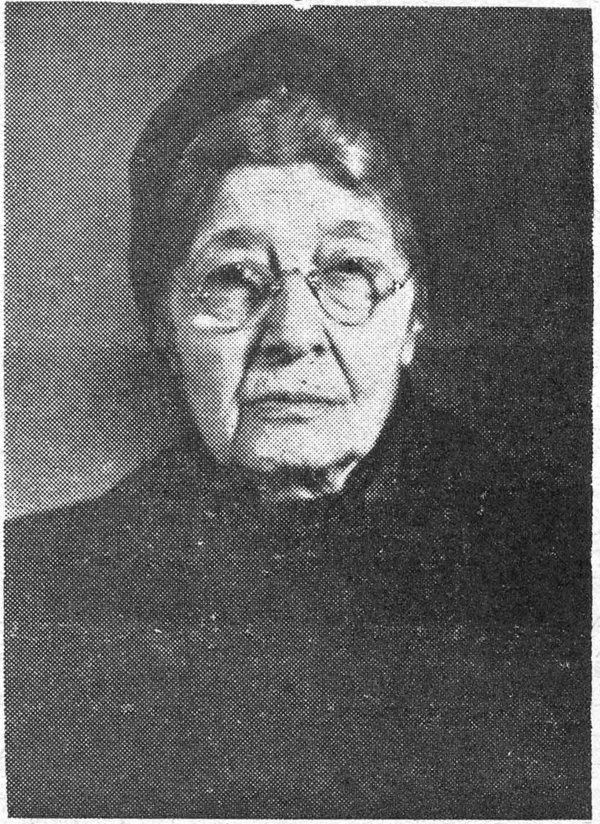
Miss Amelia Youssef Badr
A woman's face of the first blessed generation embraced eternal rest on the seventh of last September, after eighty-four years spent in sincere, silent struggle.
With the death of Amelia Badr, Lebanon and the Arab world lost one of their faithful pioneers, a singular model of the good "teacher." She carried the torch of learning from Lebanon to the sister country, Egypt, and at the American College for Girls in Cairo she enlisted herself in raising the daughters of her sex upon the foundations of virtue and goodness; by her drive and her self-denial in work she rose to the post of adviser to the principal and head of the Arabic department of the institute...
Teaching was never for her a trade that brought in money; it was an art to be practiced and a passion to be loved, to which Amelia gave herself for 57 years. She was the link
between the administration and the families, and she won the trust of all. With surpassing love she watched over three generations of the girls of Egypt, to whom she was more tender than a mother and closer than a friend, and the finest example of good discipline, uprightness, and diligence.
Eighty overtook her while she was still on the field, going on with her mission, defying the years with a faith and a resolve that knew no weariness; and but for the insistence of those in charge and of her friends, the mighty campaigner would never have consented to lay down her arms and shake the dust of battle from her. At last she bade farewell to the valley of the Nile and came home to her homeland, Lebanon, to spend her final years in contemplation, in the care of her nephew Mr. Fuad Badr, owner of "Dar al-Kitab." She was borne from his house at Dhour el-Choueir in a funeral simple and majestic, and laid to rest beneath wreaths of flowers, amid the true tears of hundreds of her pupils, present and absent. The Egyptian papers mourned her as the great are mourned; for Amelia Badr, though in her own country she remained an "unknown soldier," was in truth a modest, giving human being. She lived great and she died great.
"The Woman's Voice" bows in respect before the noble departed and strews prayers of mercy upon her noble and pure soul.