this engaging account of the conference...
The conference opened on the morning of September 9 last in the great hall of the Sorbonne, and the speakers set forth their view of the rapid progress the sciences in general have achieved thanks to the use of radioactive elements, and the benefit this holds in the applied fields. They paid tribute to the importance of the peaceful side of the nuclear sciences, and they acknowledged as well the immense responsibility laid upon the shoulders of the scientists and workers in nuclear science.
The papers were divided into two principal divisions: the first concerning radioactive elements in their physical, chemical, and technological aspects, and the second in the biological sciences, medicine, and industry. In the evenings, scientists from the United States, Russia, the United Kingdom, and France lectured. Sir John Cockcroft spoke on the future of nuclear energy, pointing to the pressing need felt by Western Europe in particular for this source of energy if it is to continue its advance in civilization, and he mentioned the special attention the United Kingdom is giving to the generation of energy from nuclear fusion. Dr. Taylor also spoke, on the subject of exposure to nuclear radiation and the smallest amounts to which those working in the nuclear field may be exposed. Dr. Seligman spoke on the subject of radioactive elements and their possibilities in the near future in agriculture, food, and industry. As for Dr. Libby, his address was on the economics of radioactive isotopes; he mentioned that the annual savings in industry in the United States have now reached nearly 500 million dollars, and this saving is expected to reach 5,000 million dollars by 1962, when the use of this technique becomes general in agriculture,
pharmaceuticals, medicine, and other fields.
Those in charge of the conference's work arranged, in agreement with the officials at Saclay — the French center for the nuclear sciences — a trip to visit those laboratories, where I saw many of the apparatus, the researches, and the scientifically productive work. There are today at this center two nuclear reactors of different designs, the larger of which generates 15 million watts.
During my visit to Saclay, in the sessions of the conference, and in my meetings with the member scientists, I kept asking
myself where we in Lebanon stand in relation to this interest and this rapid scientific progress in every region of the world. It is rare to find a nation that has neglected this vital field as is the case in Lebanon. Nations attend to the nuclear sciences, organize research centers for them, nourish them from the state's funds, and encourage scientists by every means. And we see that the small nations, on the whole, do everything in their power to produce scientifically, for they see that this is the one field by which they can prove their existence as a state deserving of consideration and of survival. But in Lebanon we lie snoring while the world runs — here we are, not yet even begun.
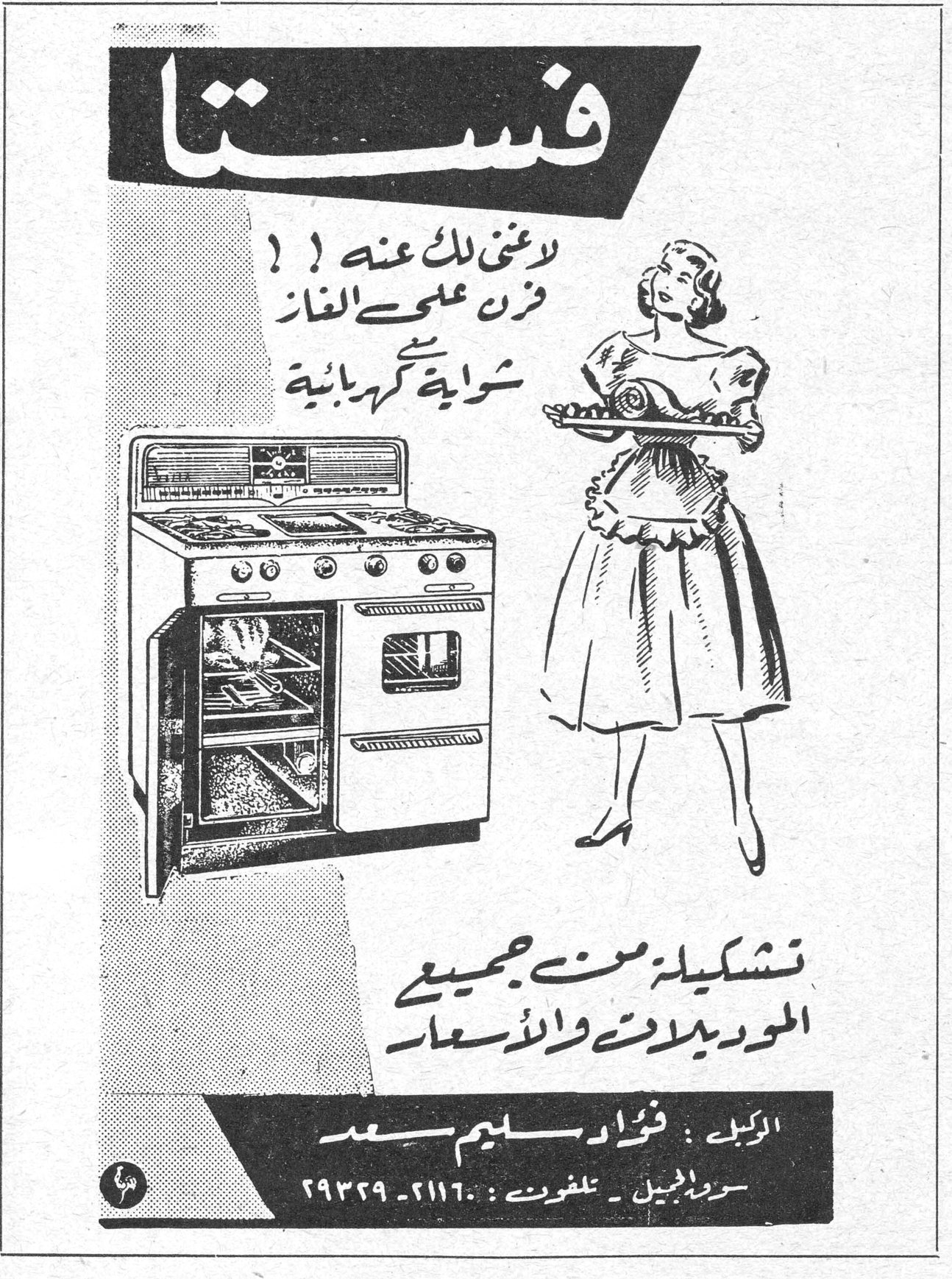
Festa
You cannot do without it!!
A gas oven
An electric grill
An assortment of all models and prices
Agent: Fouad Salim Saad
Souk al-Jamil – Telephone: 21160 – 29329