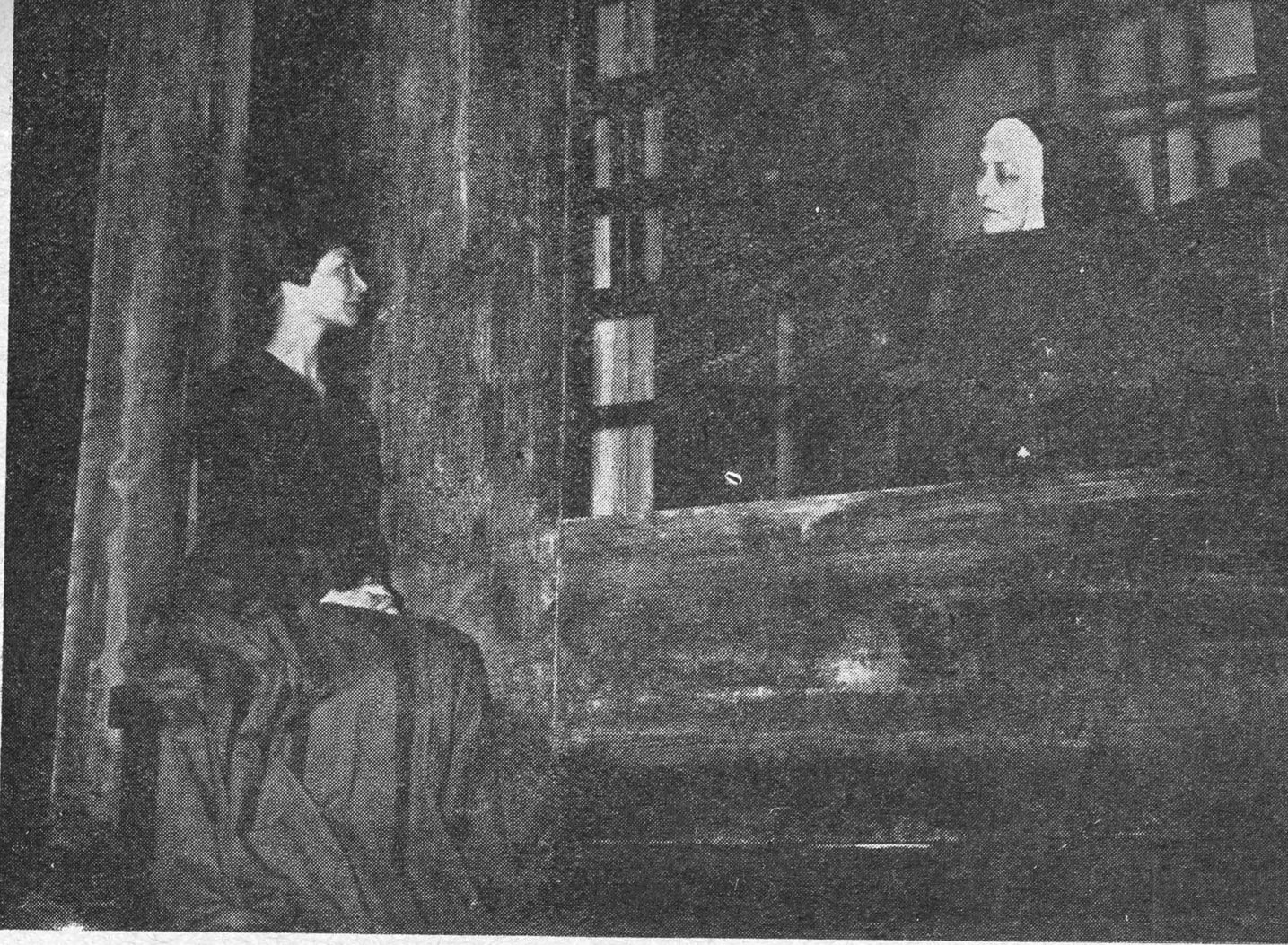
And have you thought of the name you wish to bear?
Blanche de la Force (Emmanuelle Riva) asks the Superior (Annie Cadialcum) for permission to enter the Carmel
Dialogues des Carmélites G. Bernanos Marcelle Tassencourt Hébertot
Dialogues of the Carmelites By the French writer Georges Bernanos Directed by Marcelle Tassencourt At the Théâtre Hébertot
In 1947 Father Raymond Bruckberger and the director Philippe Agostini asked the well-known writer Bernanos to write the dialogue for a film they were making from a German story by the writer Gertrude von Lefort (Gertrude von Lefort), entitled "The Last on the Scaffold." The German writer had drawn the material of her tale from a historical incident well known in the chain of the Terror of the French Revolution: the execution of sixteen Carmelite nuns on the guillotine on July 17, 1794...
When people of the theater came upon this cinematic dialogue, they found in it the simplicity of the classical style, the violent conflict of true tragedy, and deep inner upheaval — in a word, all the essential elements that make of it a true theatrical piece. The German, Italian, and French stages adopted it; it was translated into many languages and performed in differing styles, and in every setting it won the admiration of the public and their feeling that they stood before a lofty classical theater. Bernanos, the well-known novelist, revealed himself a rare playwright, and he has left to the theatrical heritage a solid piece that rises to the summit of immortal tragedy.
The subject of the play is "fear" — the primal, natural fear whose seeds are planted in the depths of the human soul; the fear that human beings try to overcome, so that some reach the heights of heroism and courage, most arrive at a moderate position around which their personalities settle, while some it seizes with its instinctive force until the soul becomes
its prey, and it takes on a morbid psychological form under which the moral powers collapse, casting its victim into cowardice, humiliation, and contempt.
Blanche de la Force, daughter of the Marquis de la Force, is an aristocratic girl with an ample share of beauty and culture, raised in one of the old French families, possessing every worldly blessing she could desire; but her nerves are weak, and terror seizes her and robs her of the pleasure of life. She fears the dark, and noise, and the gathering of crowds, and she suffers torments of the soul because of this fear, for she tries to fight it and despises herself on its account — indeed she counts her very existence a disgrace to the name of her honorable family, which in times past gave the homeland heroes of war and defenders of the land...
Here she is at the door of the Carmel, asking the Mother Superior to accept her among the daughters of the convent. The Mother hesitates greatly, and after a long discussion in which she shows her the difficulties that await her in a life of austerity and seclusion, she asks her:
— And have you ever thought of the name you wish to bear if we accept you into our convent?...
— Yes... I have thought of it... I want to be called Sister "Blanche of the Agony of Christ"!
Signs of astonishment and wonder appear on the old Mother's features, and she motions to her with her hand, saying: "Enter in peace, my daughter." For the Superior had thought of that very name on the day she herself entered the convent, and she found between herself and the girl a deep spiritual accord — indeed a heavenly sign that she should be received into the number of her daughters...
But this fear that drove Blanche to