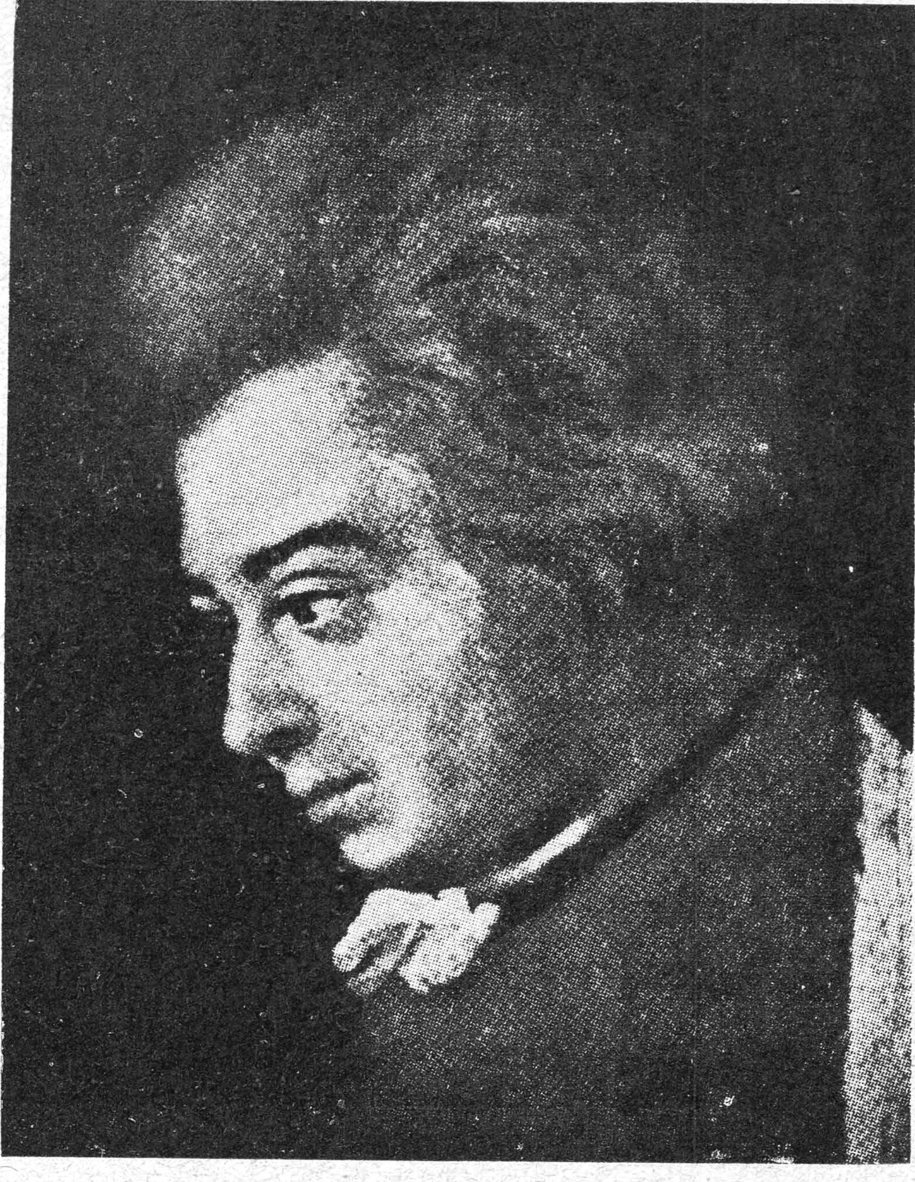
Mozart (1756–1791) is the greatest genius of all the ages, because he created masterfully in every field. Though Bach, Haydn, Gluck, and Beethoven excelled in many directions, not one of them created as Mozart did, for he was supreme in every path he entered, even though he lived no more than thirty-five years.
At the age of four he began composing. It is told of him that his father found him bent over his table writing something down, and wished to know what he was doing, so he approached him slowly, without letting him sense his presence; but Mozart felt his father there, gave him a sharp glare, and addressed him threateningly: Do not disturb me — I am writing a concerto for the piano! His father could do nothing but leave him to himself; he returned later to find, to his astonishment, that what Mozart had said was true.
In 1765 Mozart's father made a tour through the countries of Europe in his company and his sister's, to give a number of concerts, so that with their proceeds Mozart might continue his studies. The first concert he gave in London was masterly and met with great success, for the London public had wearied of the great resounding names, and it charmed them to listen to music performed by a boy not yet ten! After his return from this tour he devoted the greater part of his time to continuing his studies. A short while later he made another journey, to Paris, in the course of which he saw Gluck's operas, which delighted him immensely.
In the year 1781 he made Vienna his permanent center, and in this period he composed the immortal opera The Marriage of Figaro (1). As for the plot on which the opera's dialogue turns, it is the weakness of character of a certain count who spent most of his life teasing and pursuing young girls, particularly Susanna, his wife's maid; then the events of the story grow so entangled, as the music develops, that the matter becomes confused for the listener, until he can no longer distinguish among the characters; and the spectator's bewilderment increases when the opera ends with a scene in which most of the characters appear strolling in the garden, each of them accusing the other of the worst of intentions.
Mozart's fame had spread and had reached Prague,
which invited him to visit; he accepted the invitation, and was received with a magnificent welcome. He composed the opera Don Giovanni (1787) (1) and dedicated it to the people of Prague, to show his gratitude for their fine reception of him.
Mozart's life was beset by grave difficulties that embittered his existence and never let him enjoy a contented life. He was always in need of money, striving night and day to secure it in order to meet the costs of his living; and he had also to ward off the malice of the other musicians, who hated him out of envy of the fame he had won and the burning genius he enjoyed. To make matters worse there were the attacks of the critics, who bent every effort to destroy his reputation and belittle the worth of his compositions — all of which embittered his life and made him extremely wary and full of suspicion, until he came to believe that all people were against him. This feeling stayed with him even on his deathbed, when he believed that poison had been slipped into his food.
After his visit to Prague his health declined; at this time he finished his piece the Magic Flute, then threw himself into work on the Requiem, or mass for the dead, which is the last thing he composed. He would keep repeating to his friends that he was writing this Requiem for none other than himself. And so it was. Mozart died in the year 1791, and his funeral was attended only by
(1) Also published previously. (1) This opera was published in the previous issue of