With us, in the Arab and Eastern countries generally, this problem is not until now of any real importance, because the aged person has his respected place in the family: he is its head and its counselor. In the United States and Europe, however, where people live longer and where living is dearer, there is a tendency to extend the retirement age for those who feel in themselves, after sixty-five, vigor and a capacity to continue working. This tendency solves the moral problem, so that the aged person feels with it no despair or weariness, since he goes on contributing his share to the fruitful work of his society.
After the economic problem comes the problem of housing. It has become clear to those in charge of the "homes for the infirm" in the world that the aged person is not at ease in spirit in these homes, and prefers to them small houses where he can have independence and freedom... In England these houses have been divided as follows:
1 — For the healthy, who can manage their affairs by themselves with a little help.
2 — For the infirm, who require medical care but not hospitals.
3 — Houses for convalescence after the hospital, or for those whose relatives are away on holiday.
4 — Houses for the mentally incapacitated.
In Holland, the standard of houses for the aged is of the utmost refinement... There are the well-ordered gardens and the refreshing flowers, and every aged person has his own room, fitted with a bath and a refrigerator and everything a person needs by way of amusement. Service is assured for those incapacitated in body or in mind — and on the door of every room is the name of its occupant, who rightfully enjoys his full freedom and independence.
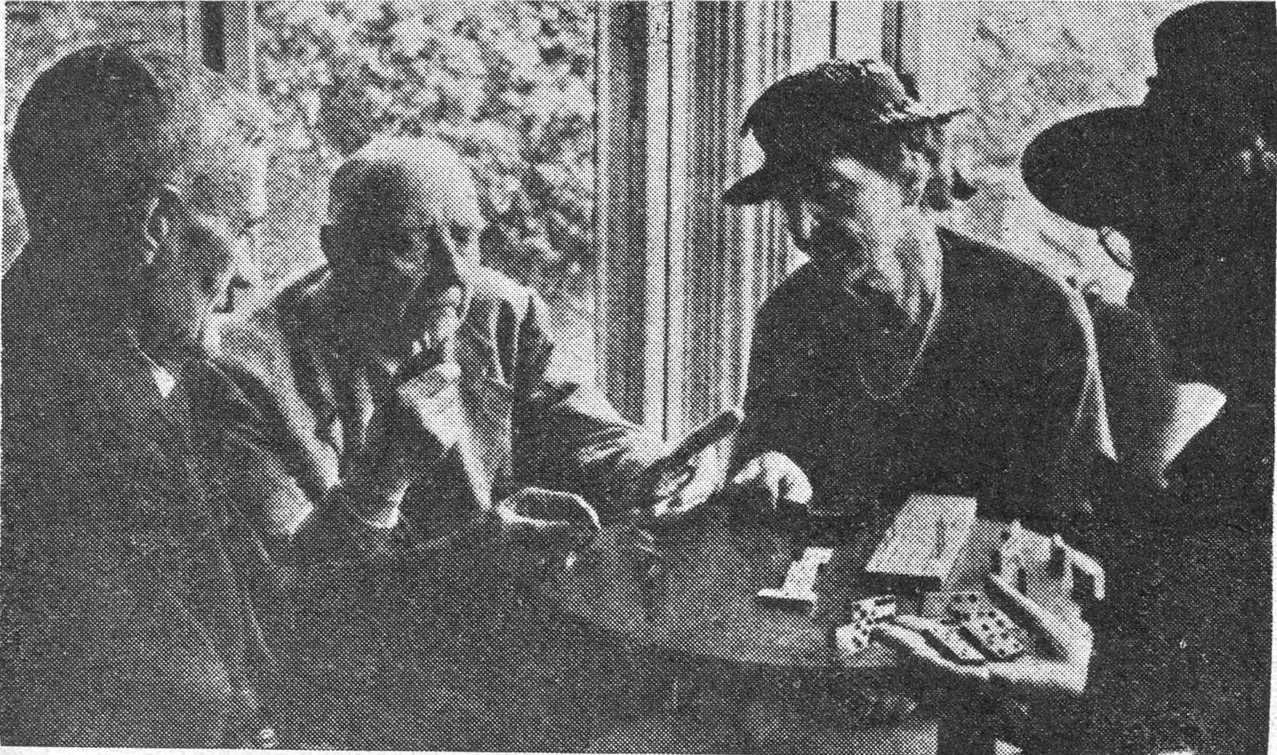
In England... a club for the aged, equipped with all manner of amusements
In the United States several experiments have been carried out to improve institutions for the aged, and enormous funds have been appropriated for them. In the state of Georgia there is a colony containing 37 houses; those who took part in building their houses are exempted from paying rent, and after its owner's death the house returns to the colony. As for those who did not take part in the building, they pay trifling rents...
The people of the colony occupy themselves with tending their gardens, or with all manner of amusements, together with one another... They are surely happy, and they have overcome their loneliness; they hold a weekly gathering, either musical or religious, and live an active social life...
In England and the United States there is an enormous number of "clubs for the aged," where the hours are organized for useful occupations and for driving away loneliness and despair. In these clubs the capacities of the aged are put to use, and every man or woman performs whatever service or help he is able for the Red Cross or for any other charitable institution.
Thus these countries have become aware of the problems of old age and have given them their due of attention, and have worked thereby to lighten human tragedies — the chief of them the loneliness of old age.