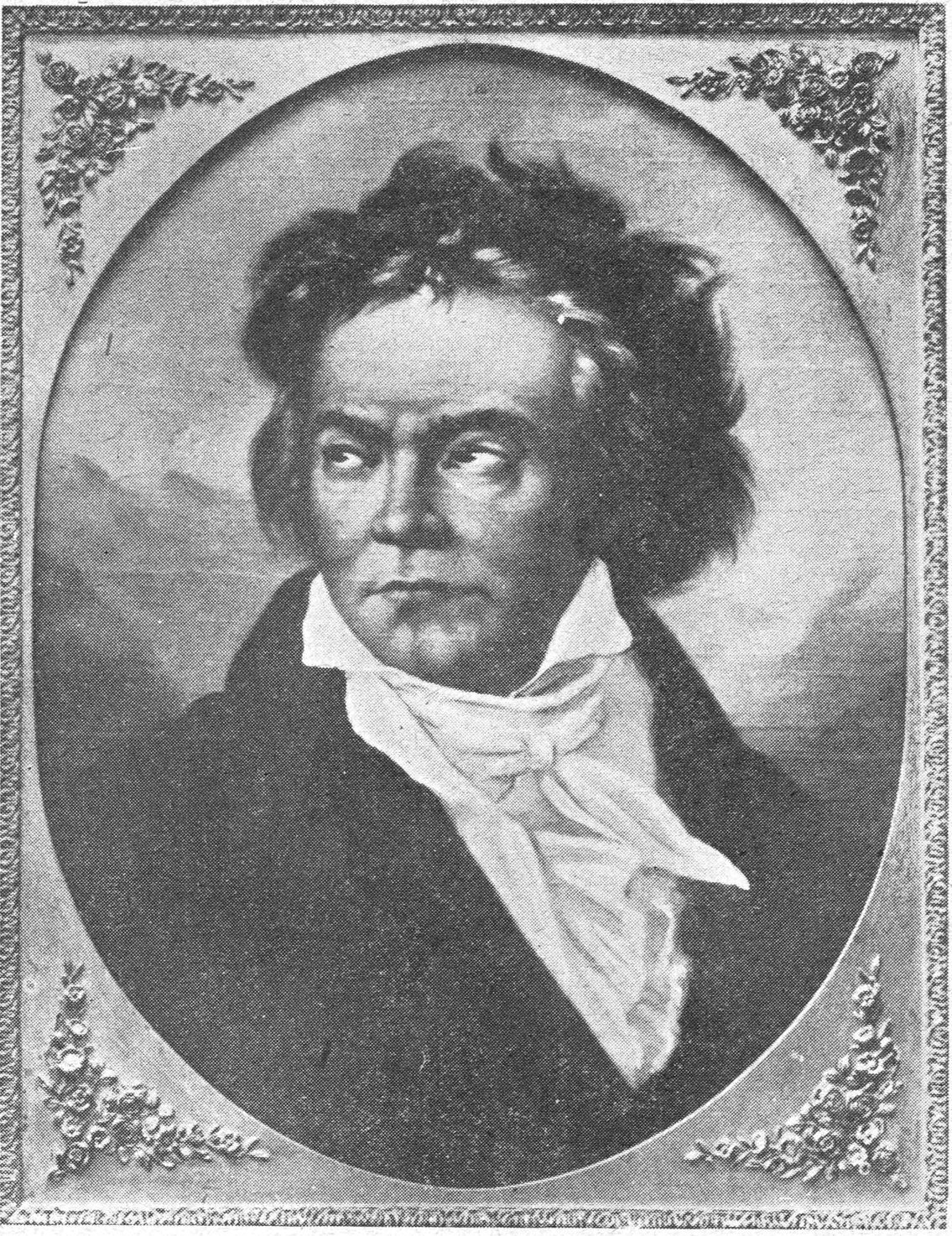
Beethoven was the summit that music reached in the classical age. He represents the bridge over which the music of self-expression crossed to the other bank... He is the close of the classical age and the opening of the romantic age.
He was born in Bonn of a tender mother who filled his heart with love and hope and who died when he was seventeen, and of a father coarse in nature and hard of
heart, who wanted to exploit his son's genius by having him play before the crowds to bring in money, though Beethoven had not yet reached the age of eight.
In 1787 Beethoven set out for Vienna, where he met Mozart, and the latter prophesied of him that he would "make a noise in the world." He gave him several lessons on the piano. After his mother's death in the same year, he returned to Bonn, where his family life worsened because of the misconduct of his father, who spent most of his time in drinking and dissipation.
In 1790 he met "Papa Haydn" when Haydn was on his way to London, and Haydn offered to give him some lessons if
he would agree to go to Vienna again. As the offer was tempting, Beethoven packed his bags and set out for Vienna in 1792, where he received some lessons in the development of musical themes at the hands of Haydn; yet despite Haydn's direct influence, he inclined toward Mozart's style. In this early period of his life the first signs of strange moods appeared in him, and his teachers were afraid of him and for him, because his ideas were ahead of his time. They did not perceive that flame which had begun to light the corners of the world, and so they considered him dangerous and extreme in his ideas — a communist, in the political language of the present age!
The story of Beethoven's life is the story of a few friends who gave him their sincere affection. Those who befriended him did not befriend him for his outward beauty; they befriended him for the loftiness of soul they felt in him. He had a head large in proportion to his body, and he never took any care of his outward dress. His short stature added to the ugliness of his appearance. Great names never intoxicated him, nor titles. He was the model of the free democrat who pays no heed to the small things that people scramble after. His brother once visited him and did not find him in, so he left his
card, on which was written beside his name: "Man of property." Beethoven promptly sent him his own card, having written beside his name: "Man of mind." He believed Napoleon to be the savior of humanity and dedicated to him his third symphony, known as the Eroica; but when he heard that Napoleon had set himself up as emperor, he flew into a rage, tore out the dedication page, and trampled it underfoot...
He was once walking with the German poet Goethe when the emperor's procession passed. Goethe drew back and stood aside,