after lifting his hat from his head and bowing in salute to the emperor; but Beethoven paid no heed at all and went on his way without turning to see what was happening around him. For this reason he lost Goethe's friendship. He never bound himself to accepted custom and convention.
At twenty-seven Beethoven began to lose his hearing little by little, and the weakness of his hearing bred in him a feeling of hatred and resentment. The loss or weakening of hearing can be borne in any profession, but it is a catastrophe for a musician. The visitor to Beethoven's house in Bonn today may see the ear-trumpets by means of which the specialists tried to avert the catastrophe.
Beethoven was quick to anger and quick to forget, noble of spirit, goodness his constant way. He paid no heed to customs and traditions if they did not accord with his temperament, and from these very qualities sprang what we feel in his music of loftiness, nobility, and perfection of workmanship.
This musician was an idealist in his thinking; he lived and composed according to the desires of his soul and the stirrings of his heart, and rarely did he compose to win favor or gain.
He esteemed woman fully and gave her her due of respect. He loved Countess Guicciardi, who refused to marry him, and to her he dedicated the Moonlight Sonata. He loved more than once, but he never married.
The hardest stage of his life began in 1822, when he lost his hearing completely; yet in spite of all this he composed his Ninth Symphony, though he never heard a single note of it with his bare ear — he heard with his spirit and his heart. It is told that he did not know of the acclaim with which the symphony was greeted during the performance until one of the players pulled him around to see — for he had turned
his back to the audience in his burning enthusiasm.
Beethoven loved nature intensely, and often walked in the forest, his hands behind his back, his head bowed, clutching a small notebook in which he set down every new idea that came to him. He wrote to one of his friends: "I wander — my music notebook with me — among the hills and valleys, setting down a few ideas. No one loves nature as I love it."
Haydn and Mozart make up the period known as the classical age,
and Beethoven came at the end of this period; he inherited the legacy of his two forerunners and added to them something new and a great power: the power of expressing the self. Though Beethoven is counted the summit that music reached in the classical age, he represents the bridge over which the music of self-expression crossed to the other bank. In other words, he was the close of one age and the opening of another: the close of the classical age and the opening of the romantic age.
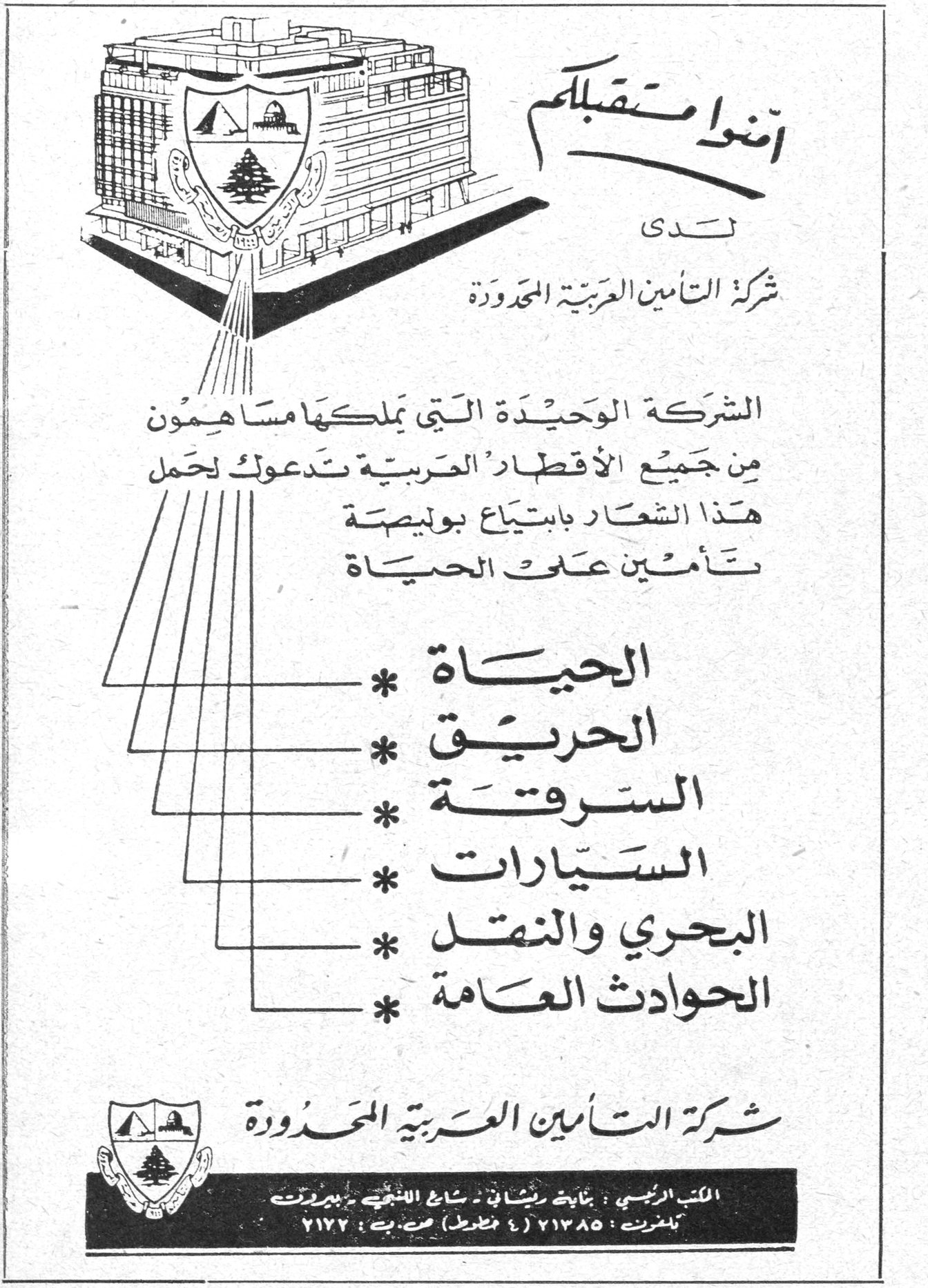
The Arab Insurance Company, Ltd.
Secure your future
with
the Arab Insurance Company, Ltd.
The only company owned by shareholders from all the Arab countries invites you to carry this emblem by purchasing a life insurance policy
* Life
* Fire
* Theft
* Automobiles
* Marine and transport
* General accidents
The Arab Insurance Company, Ltd.
Head office: Richa Building — Allenby Street — Beirut
Telephones: 21385 (4 lines) P.O. Box: 2172