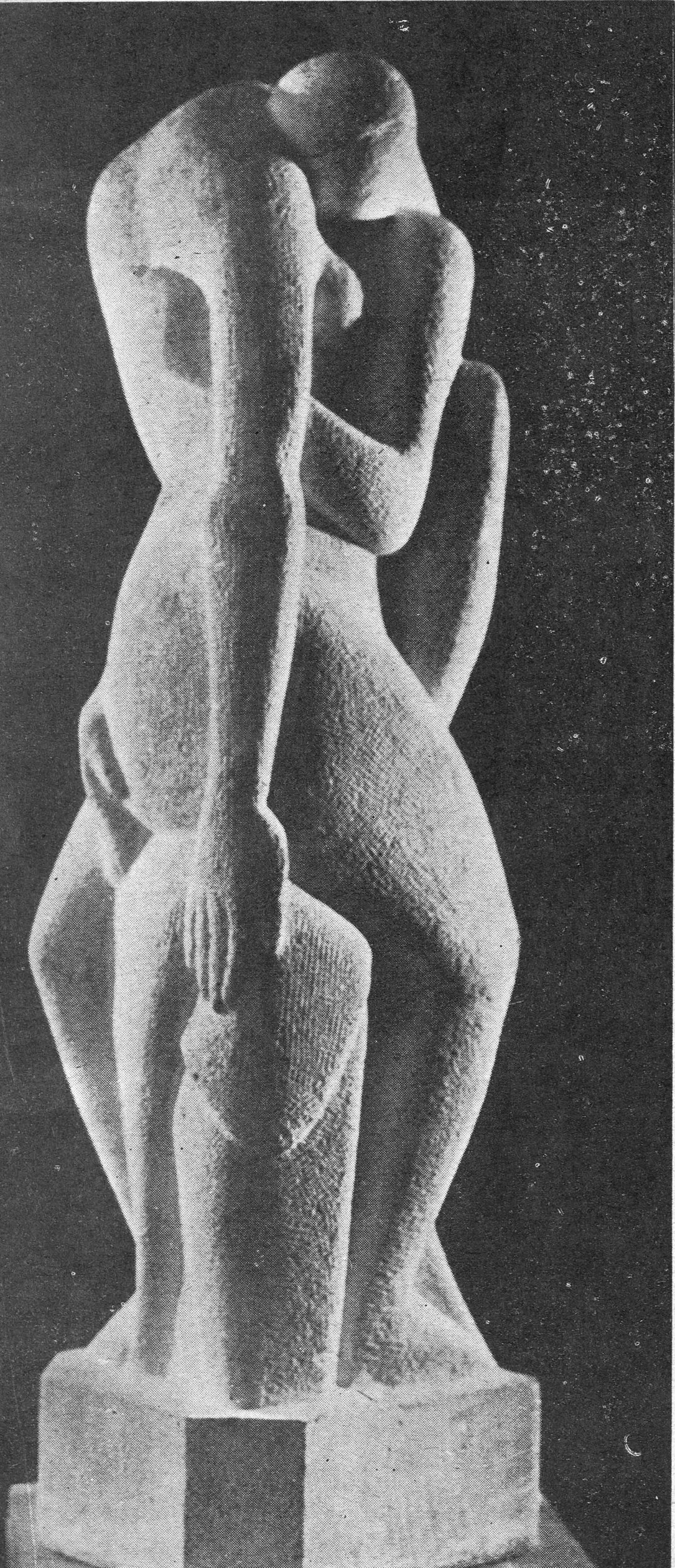
forms answered to his nature, came close to his primitive state, and expressed his inner self more than the classical did... It was then that his attempts began, for the first time, to bear his own stamp, and he left Paris for Florence, the home ground of authentic art, then Rome, then Milan, then Venice, pursuing his studies of the giants of sculpture and painting, the likes of Michelangelo and Leonardo da Vinci and others...
He returned to Beirut in 1953, having settled upon sculpture of the "abstract" kind, and he still considers himself in the stage of attempts, not yet arrived at the final, clear road.
The "abstract" school, whether in sculpture or in painting, stands in the vanguard of the schools of modern art. Here the "subject" in itself has no importance; the importance belongs to "lines, forms, and colors" — in whose harmony lies the basis of deep artistic expression.
Basbous's conviction in this school grew deeper after his recent visit to China and his acquaintance with its venerable artistic heritage, above all the ancient, where he was reassured of the sincerity of his artistic work toward himself and toward art... For he discovered that all the "modern" artistic movements now current in the Western world derive from ancient Chinese art... In China Basbous came to know "aesthetic abstraction," in sculpture and in painting alike, for the Chinese painter or sculptor, when he fashioned the god "Buddha" or the statues of China's leaders, fashioned them as aesthetic forms and spontaneous, harmonious lines, without thinking of them as persons...
It remains for the young artist, to complete his artistic mission, to draw as near as he can to the realization of his artistic self, by way of the things that stir in his imagination and between his fingers — he longs to shed outside influences and borrowing, and to arrive at creation, in keeping with his own personality...
* * *
I took my leave of the sculptor Michel Basbous full of admiration for his courage in undertaking resolute work and breaking free of classicism — he is convinced and believes in himself, and therein lie his strength and his assured success...
It is true that before his statues we feel bewildered... but a longing takes hold of us to understand this obscure kind of art and to grasp its secrets... And as we study the curving of his lines, we sense that behind them lies something hidden, expressing a deep and sincere
Desire