On her blue "mosaic" terrace, at her residence on one of the heights of Rabat, the princess herself sat amid a heap of blue and yellow cushions, sipping her tea from a glass, her eye on the verdant garden, talking of freedom. She seemed somehow tired and weak of faith... Behind her stretch centuries upon centuries of long-rooted heritage and antiquated thinking... It is a heritage most of which she takes pride in, but if Morocco is to catch up with the caravan of civilization it must come out of the shell of the past, and this is to be done by "renewal," not by "revolution" — the latter destructive, the former constructive. And it is for the rising generation to carry out this renewal...
Princess Aisha enjoys, in her country today and under the direction of her father King Mohammed V, a freedom that is not inconsiderable. She wears European clothes; she walks in the streets and mounts the platforms of public gatherings unveiled; she drives a car; she swims. But she is not permitted to attend public parties likely to include unmarried young men. She is free to dance in France and in America, but not in her own country, where she lowers her gaze merely upon meeting a strange man face to face... Her friends sometimes describe her as "a bird in a golden cage!"
XXXX
Two civilizations contend in Morocco today: the first Eastern, Arab, and conservative; the second Western, French, and extreme. Mohammed V is trying to unite these two civilizations, borrowing from the second everything that may advance his country,
on condition that it not collide with the principles and laws of the Islamic religion. The King derived his power, at the outset, from the French. It was they who chose him, over his elder brothers, in 1927, to succeed his father on the throne. And it was they who permitted him, after his coronation, a journey to Europe, from which
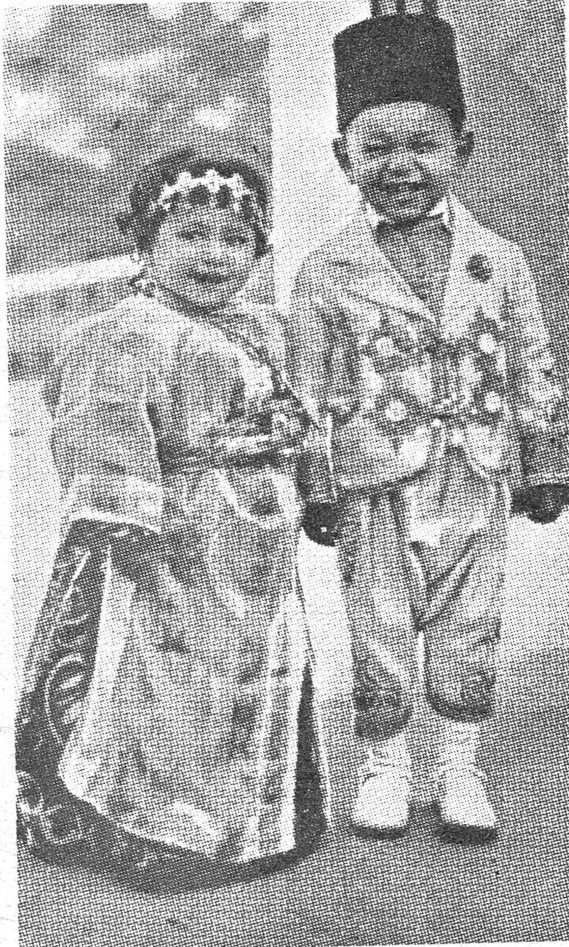
Princess Aisha with her brother Prince Hassan in their childhood, in Moroccan dress.
he returned full of admiration for the manifestations of Western civilization and eager to borrow from it whatever his religion and his traditions would allow. And so, when his firstborn Moulay Prince Hassan was born in 1929, the Sultan went himself to Paris — he was then only 19 years old — and brought back with him a complete layette for the child, and a French governess. A year later Princess Aisha was born; in 1933 Princess Malika was born, and then Princess Nezha in 1939 — all four of one mother.
As is the custom in royal families, the upbringing of the royal children was entrusted first to a nurse, then to a governess, and their mother was rarely permitted to interfere with the precise and rigorous order of their lives. They ate, slept, exercised, studied, and prayed by the clock... Each child had a Moroccan nurse and a French one, and so they were trained in the Moroccan and French ways of life at one and the same time, and learned the Western rules of conduct in addition to their Arab Moroccan traditions. The King personally supervised this double upbringing, visiting his children several hours a day, watching them at their lessons, their meals, or their play, and giving his orders and direc
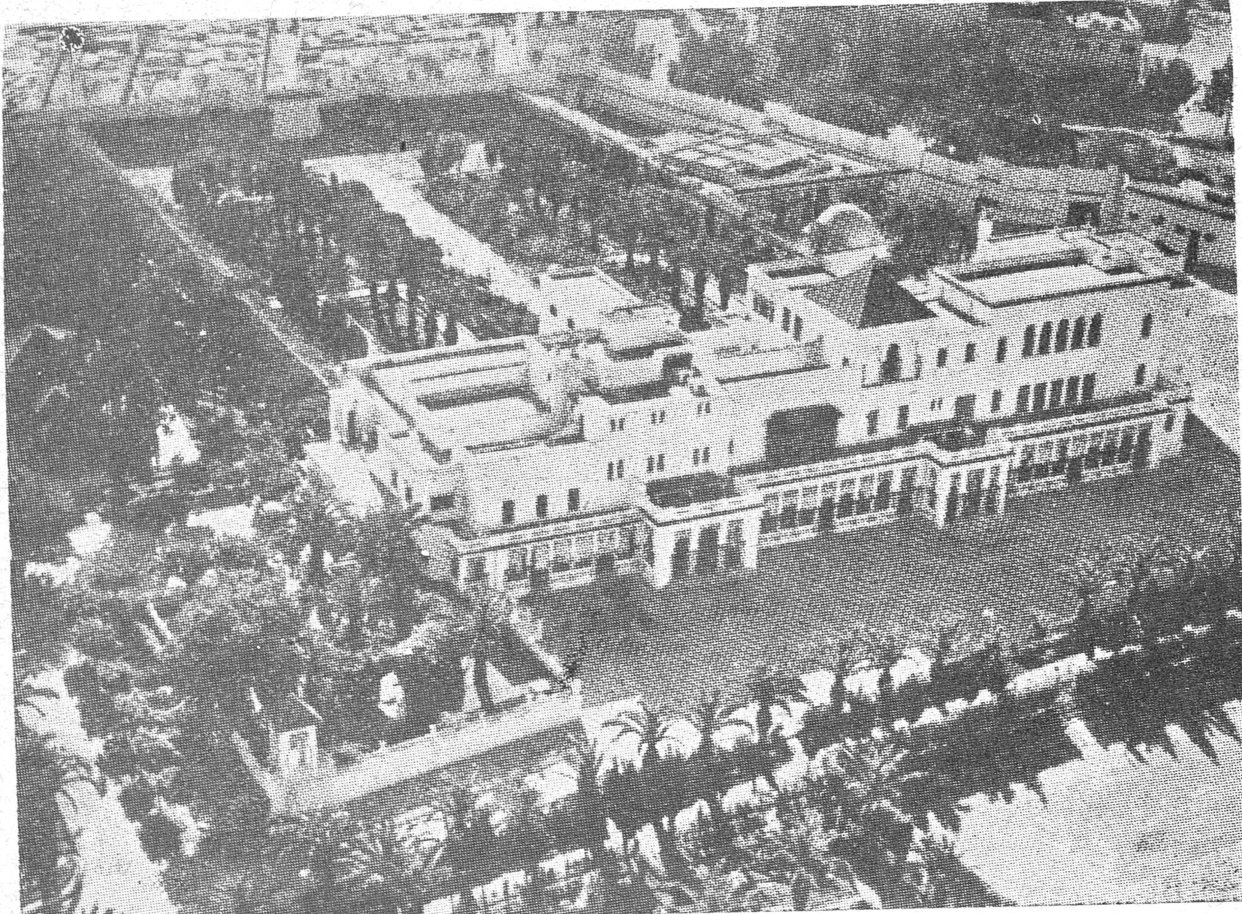
One of the Sultan's sixty palaces, where Princess Aisha grew up