tions... In their little world they were allowed to call him "Papa" instead of "Your Majesty." It was he who wiped away their tears and kissed their knees when they tripped and fell in their play and their running... And so the little princes and princesses learned to love their father and respect him at one and the same time.
In their private palace he showered them with gifts and sumptuous clothes. On the national holidays they appeared in ornamented Moroccan dress, while their wardrobes were filled with the newest and most elegant Parisian clothes... for every occasion and every season.
With the passing days their world widened, and its bounty overflowed in the form of gifts of every color and every desire. In what ease and luxury the four royal children lived! Yet they remained in the atmosphere of the palaces and rarely accompanied their father to public ceremonies, except on Fridays, when he went to the mosque to perform the prayer. Little Aisha would wear a short white frock and a sun hat — and her French governess insisted that she wear gloves! Hassan wore a long white djellaba, in keeping with the local dress.
In their private school, built expressly in the neighborhood of the palace, the little royal children enjoyed everything that could occur to a teacher's mind in the way of modern means of instruction and recreation together: a swimming pool, a tennis court, and a playing field with complete athletic equipment. The children learned skiing, horseback riding, and swimming at the hands of the most skillful instructors...
"I still love swimming, riding, tennis, and skiing," says Princess Aisha, "despite the
strictness imposed on us while we were learning them, by the instructors and by my father... He was most insistent that we master these sports, and he was right..."
In this soft and happy atmosphere Aisha grew up. When she reached sixteen, having finished her lessons at the palace school, her father the King summoned her, handed her a paper, and said to her in a serious tone: "This is a speech on the subject of 'the awakening of woman.' You are to deliver it before a great gathering of women — and without a veil!" And so Aisha took up the speech and did as her father commanded; nor did the "heroine" know, that day, how great an effect her speech would have on the daughters of her sex, who regarded her as the standard-bearer of woman on the road to renaissance and emancipation.
Princess Aisha then went on to complete her higher studies at a French college for girls in the European quarter of Rabat, where most of her companions were the daughters of French army men and senior administrative officials. In this period the princess was keenly intelligent, upright, frank, and modest... So her companions described her, and she is still distinguished by these same qualities. But after four years of study at the French institute, the princess found herself frequently clashing with her companions in opinion and belief... so much so that they often misconstrued the freedom she enjoyed, and criticized her conduct and her manner of dress...
"But," her father reassured her, "no one on earth escapes the tongues of criticism — how much less a princess?... And you are in the right, so long as
you believe that your conduct is correct... Only, you would do well to keep away from the eyes of the photographers while you are in your bathing suit... It is enough that people know you swim!"
As for the veil, which Princess Aisha was the first to cast off, the girls and women of Morocco cast it off after her by the thousands upon thousands... Once the princess put on a veil, by way of a joke, and went out with a bouquet of girl friends to watch the King's procession and the celebrations of the anniversary of his accession to the throne. She remembers, laughing, how she kept tripping over her robes!...
With the days the King's popularity grew and his leadership gathered strength; the French feared for their supremacy, and by a contrived plot they surrounded the palace and led him away captive to the island of Corsica. That was in the summer of 1953. Three days later his family was permitted to join him — it all happened with extreme speed and without preparation — and when they returned to their palace two years afterward they found it in a pitiable state.
We shall not speak at length of the days of captivity, for their events are painful to every member of the royal family. One of their close friends has
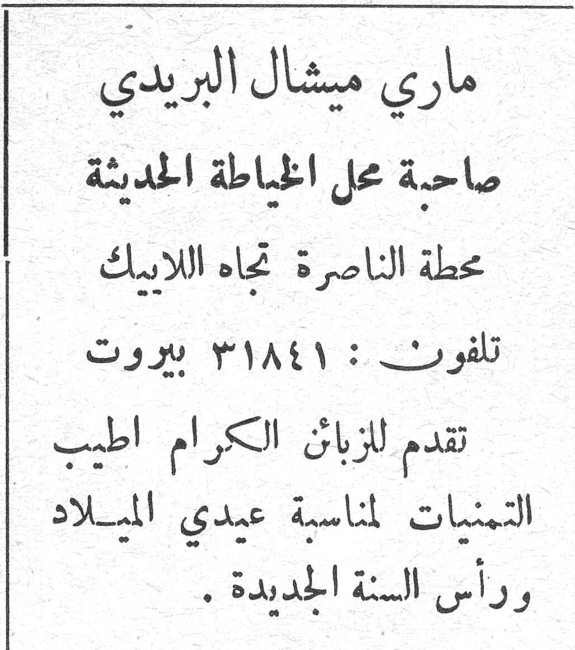
Marie Michel Bridi
Proprietress of the Modern Dressmaking Shop
Nasra Station, opposite al-Labik
Telephone: 31841 Beirut
Offers her dear customers her warmest wishes on the occasion of the feasts of Christmas and the New Year.