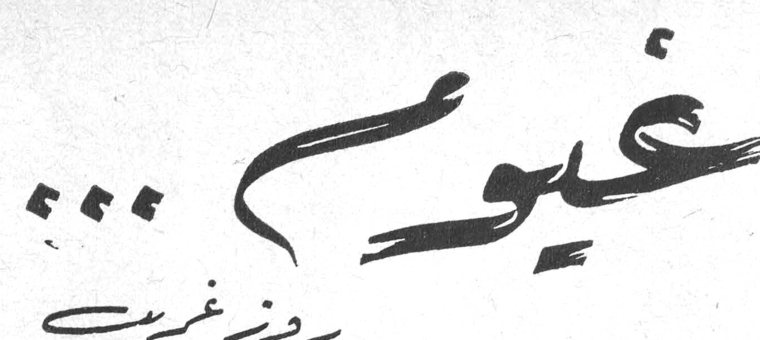
The freedom you women are chasing is nothing but illusion and fantasy!
My interlocutor threw out these words and turned in his seat with a nervous movement. Then he passed his hand over his upper lip like a man trying to twirl an imaginary mustache of which the barber's razor had left nothing.
When he got no answer from me, he went on:
He who has grown used to slavery remains a slave, and finds bliss in slavery even if he lives in an air of freedom. Like that fish which a glass barrier kept from reaching the other half of the water vessel. Every time it passed the barrier it drew away, for fear of colliding with it. At last the barrier was lifted, and still the fish, whenever it passed the spot, drew away in fear and made no attempt to cross.
I sensed in my interlocutor's face some news he could not keep to himself; he needed to unburden it. So I asked him: And what has driven you to this philosophizing?
He straightened in his seat and said:
I have spent no small part of my life defending woman, calling on man to do her justice — not because I believe, as some zealots do, that woman harbors great latent powers, but because I incline to championing right against wrong. I defend woman when man wrongs her, exploiting her or tyrannizing over her. And I defend man likewise when woman burdens him with her demands and lives as a parasite upon him.
In our neighborhood lives Jamil Abdallah, known for the coarseness of his character and the ugliness of his face... as if those who named him Jamil had set out to mock him. Not a day passes without our hearing his shouting and his curses. People have put his ferocity down to a chronic stomach ailment that struck him when he was young. And though they loathe him in secret, they are not sparing of courtesies toward him, because he is rich. It is this wealth of his that enabled him to obtain a beautiful wife some twenty years younger than himself... This wife has endured from him what a man condemned to hard labor endures. He flies into a rage at the slightest cause, and sometimes at no cause at all, and falls to cursing and yelling. I will not tell you of his stinginess and cruelty; you have no doubt seen samples of this miserliness that borders on madness, which makes its owner guard a single piaster as he guards his own life — nay, more.
This man had a daughter named Nahla, who resembled
her mother exactly in charm and beauty. But from childhood she was more inclined to freedom and less docile than her mother. She spent several years of her girlhood with an aunt of hers in Beirut, where her eyes opened upon a world other than the world of the village, and there she received some learning and some modern ideas. From the time of her return home, suitors hovered about her, drawn by her fair complexion and her blue eyes. Her father coveted marrying her to the richest of them, and despite his wealth he refused to spend a single piaster on what they call a dowry or a trousseau. He takes care to reserve his money and his property for his male children.
One day there came to ask for the girl's hand a middle-aged widower of great wealth, who resembled her father in many respects. Her father saw in him the son-in-law he had been seeking. And I began to wonder: would the girl submit to the father, and history repeat itself?
The girl resisted as long as she could. A violent struggle broke out between her and her father, and lasted for some time. The mother all the while kept silent, offering no opinion and not daring to intervene. Then one day someone came along who persuaded the girl to accept, because "as long as her father was set on his resolve, no new suitor would come her way. And since Amin Barhoum was rich, she would live with him like a queen. Her life at home had grown hard, what with her father's anger and obstinacy. And it was high time she became mistress of a house, with servants hastening about her and watching over her comfort, wearing whatever clothes and jewels she desired."
• Freedom is a relative thing, and cannot be attained in full. There is no doubt that the woman