An interview exclusive to The Woman's Voice

Women's literary activity in England is no less prominent than the activity of men. In poetry, for example, the name of Edith Sitwell shines, fearing no eclipse, on the summits scaled by Yeats and Eliot. And so it is with Virginia Woolf, Elizabeth Bowen, and Phyllis Bentley in the world of the novel: their works are read, criticized, translated, and made into films in as great a measure as befalls the works of the great writers.
And it pleased me that the women readers of "The Woman's Voice," and its men readers, should have the good fortune of an acquaintance with one of the pioneers of modern literature in England — I mean Phyllis Bentley — through the information that reached me about her, or from her directly.
Our novelist is an author as well known in the world of the story as she is in the world of criticism, or in the domain of sociology. She has more than one book of critical study, such as "Some Observations on the Art of the Novel." She holds a doctorate in sociology. In the novel she has ranged widely and fruitfully; among her works in this field, the film companies have produced "Inheritance," "West of Yorkshire," and "Noble in Mind." And beyond her written output, she shows a notable social effort, and overflows with an astonishing vitality despite having passed her fifth decade.
I asked Dr. Bentley about the particular aspects that interest her in the field of the novel, and she answered:
— I am from the industrial region of Yorkshire, and I am a specialist in sociology, so it was natural that I should concern myself with this region in particular, and treat its problems on a psychological, analytical, social plane.
— And what is your method?
— Realistic on the whole. I aim above all to show the effect of inner emotion in the human self upon its conduct in life.
— And do you work by the inspiration of a particular political doctrine?
— No. My doctrine is social justice, and my guide is devotion to art and the service of man.
— Is it true that the number of women novelists in England exceeds the number of men?
— That was so during the last war. Now I do not believe it. Perhaps it holds true in the United States.
— And what is the influence of the American novel on English literature?
— Slight. Ernest Hemingway, for example, influenced no one but Virginia Woolf.
— And you — by whom were you influenced?
— I was influenced above all by Thomas Hardy.
— By what writer of the world has the modern English novel been influenced?
— It has been influenced by Marcel Proust as a novelist, and by Freud and his psychological school.
— What do you say to Somerset Maugham's opinion that the artist does not trouble himself with
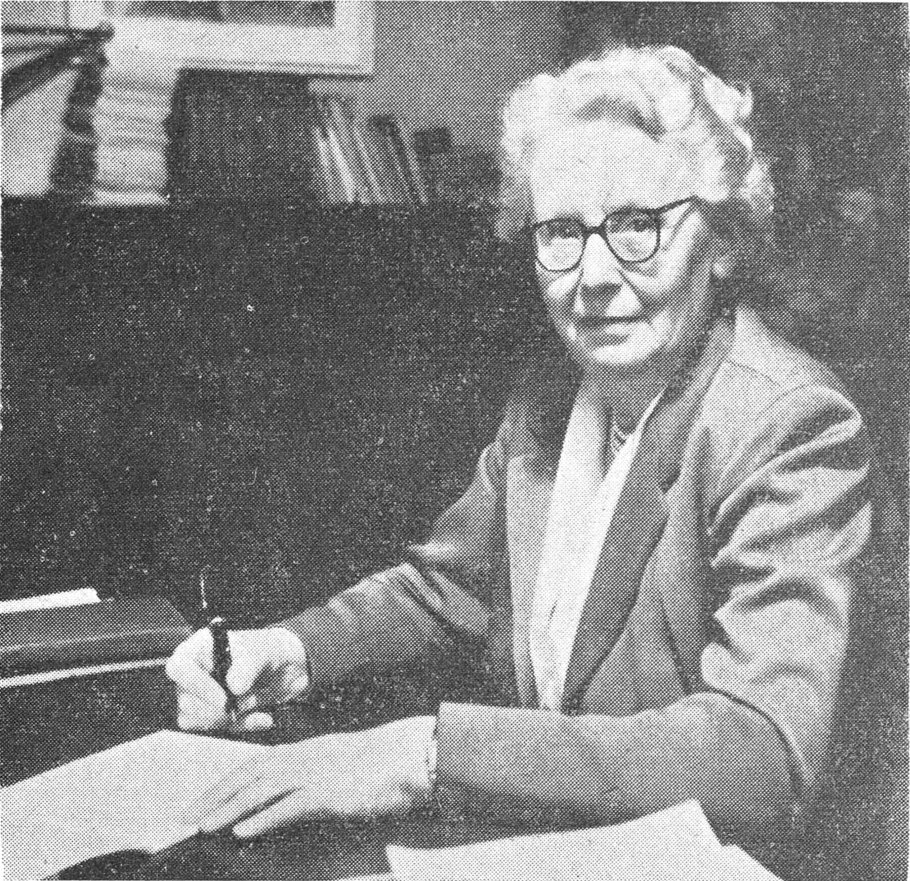
Dr. Jamil Jabr, during his journey to England last autumn, acquainted himself with the intellectual and literary movement there, and he has favored "The Woman's Voice" with this delightful interview concerning Dr. Phyllis Bentley, who is rightly counted the greatest living English woman of letters, above all in the activity of the novel... Our thanks —