A black cloud passed over the sky of Lebanon in the month just ended. It robbed us of sleep and alarmed every mother and father, stirring our forebodings, painting the future for us in the ugliest of pictures — and it proved that the conscience within us does not sleep for long.
For this the Lebanese woman rose up, studying what she might do in such difficult circumstances, and how she could help to deliver the country from this predicament. There was the statement of the League of Women's Organizations; there was a committee that called upon His Excellency the President of the Republic; and there were writings on the subject. The Lebanese Women's League, likewise, is continuing to hold meetings on such matters.
We have held that radical action should be taken, to protect the future from individuals who have sold their consciences and trafficked in the white-slave trade; and that the moral responsibility resting on the shoulders of the Lebanese woman should be examined anew:
There are conceptions belonging to modern educational theories that do not apply to the Lebanese reality. There are morals native to us that are being abandoned in order to embrace the morals of civilizations foreign to our life. There are ways of behaving, among women and men alike, that do not accord with the future they want for their children.
The flabbiness of Lebanese young men spoils for the Lebanese girl her high ideals and her reserved upbringing; and the young men's failure to marry at an early age is the outcome of social conditions caused by our scant regard for the evil consequences that may follow.
Our sons, who will become judges of right among men, and our daughters, who will rear those judges, must have wakefulness of conscience and the
sense of responsibility planted within them. The school that educates our children — what are its ideals?
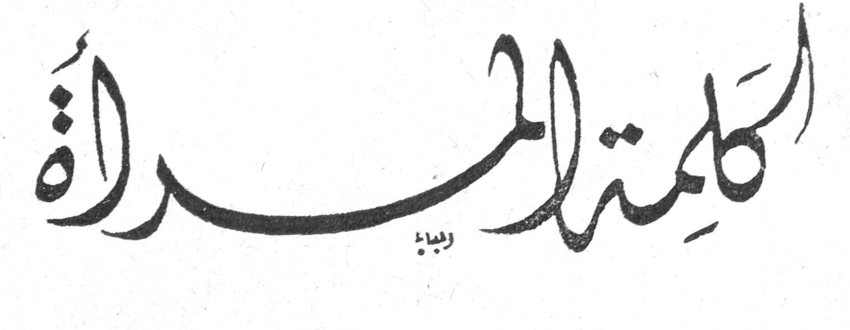
It behooves the Lebanese woman, amid this moral chaos and at this historical stage, to speak her word plainly:
This is a state of affairs I will not
accept: it threatens my existence and my position, and threatens the future of my children, and so of the homeland. Let us then take the question by its roots, and let us define morals. What are they by Arab or Lebanese custom? With what virtues are the Lebanese girl, the Lebanese mother, and the Lebanese man to be adorned? What quantity of the contemporary civilizations are we able to digest? What qualities of our historical heritage must we preserve? Can we forget our heritage and take over another's heritage entire? How are the home and the school to carry out the work of making Lebanese for Lebanon? What are the things that hold the homeland back from winning the race of civilization, and how are they to be set right?
All of these are matters in need of serious treatment. Might there not be a booklet, issued by the women's organizations, on character and morals, distributed to Lebanese families — to be the dictionary of the student, boy and girl, of the mother and the father, lighting the future before them and making them proud that they are of Lebanon, and that in Lebanon there is a woman awake?
It shames our moral pride even to put into words the degrading events which, for a month now, have been the talk of our old men and our young men in Lebanon — and even of our little children... What, then, is the stand of the Lebanese woman toward this abnormal state of affairs?!