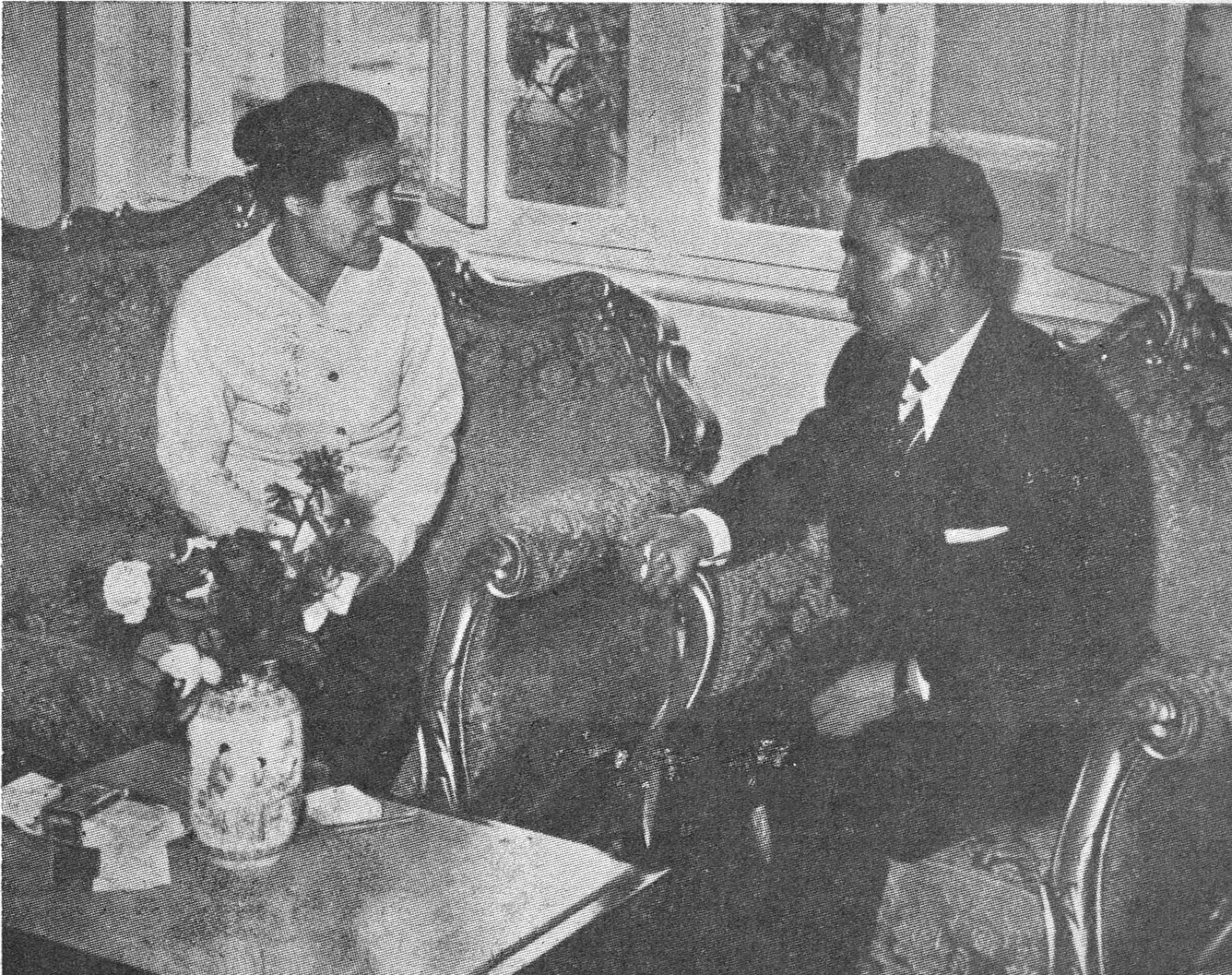
The chargé d'affaires of the Moroccan Embassy in Damascus speaks to the correspondent of 'The Woman's Voice'
The article that appeared in the last issue of 'The Woman's Voice' caused a great stir in Damascene circles, which roused the zeal of our correspondent in Syria, Miss Inayat Ramzi, to speak on this subject with the Honorable chargé d'affaires of the Moroccan Embassy, Mr. Abd al-Rahman al-Fassi. His Excellency was keen that his reply appear in The Woman's Voice magazine, in view of Princess Aisha's connection with this magazine's women readers throughout the whole Arab world, and in view of the respected standing enjoyed by the Lebanese Women's League, which publishes 'The Woman's Voice,' and the standing of its editorial board.
The conversation between Mr. al-Fassi and Miss Ramzi began in a corner of the halls of the Orient Club in Damascus, during the reception given by the Syrian Arab Women's Union on the eighth of last January, and she inquired of him as to the truth of what 'The Woman's Voice' had published concerning the patronage by Princess Aisha, leader of the women's movement in Morocco, of a Jewish vocational association there.
Miss Ramzi had, while Her Highness the Princess was attending the general congress of the Arab Women's Union in Damascus last summer, asked of Her Highness that she kindly, after her return to Morocco, found a branch of the Permanent Bureau of the 'Every Citizen a Sentinel' committees — this because of the deep impression she had observed in Her Highness's person of the savage consequences the Palestine catastrophe has created among our brethren, following Her Highness's visit to the front line and to the refugee camps.
Out of a desire to bring the truth to light, to clear Princess Aisha's name, and to repel the accusation from her, the Honorable chargé d'affaires kindly gave the following reply:
It matters to me to comment on the article carried in this magazine, although I know that our Arab brethren in Lebanon, where this magazine is published, and in Syria, know things as they truly are and have no need of any clarification or comment. But it is important that I draw attention to the fact that the Jewish community in the Arab Maghreb has, since the Islamic conquest of these lands, been distinguished by a special status: it has its own quarters, as it has its own judges from among the spiritual heads, who decide personal-status cases among themselves according to their teachings. It is this which, in the commentary on this subject, is called the original or particular Jewish culture — as a safeguard against a Jewish culture tinged with Zionist principles.
This Israelite community has likewise had, since ancient times, its own schools, which Muslim Moroccans do not attend, because they are reserved for the children of the Jews; and the programs of those schools do not go beyond the scope of the French baccalaureate curriculum, or vocational instruction, to which are added the teaching of the Jewish religious doctrines and the principles of their worship, along with certain subjects of financial and commercial instruction, such as bookkeeping and the like, since the majority of the Israelites in Morocco practice trade after leaving school. All these schools, and the community's own courts, fall under the supervision and care of the competent Moroccan ministries, headed by Arab Muslim ministers whose minds could never accept — nor would their national feelings or their history permit them — to shut their eyes to any Zionist movement or activity that might creep into such establishments.
I add to this that there
The Honorable chargé d'affaires of the Moroccan Embassy in Damascus speaking with Miss Inayat Ramzi