
This column is edited by: Ziyadeh Awwad
It appears that the close of the year 1957 was the beginning of an easing of the international crisis which had defied the great powers in the Eastern and Western worlds. The crisis of disarmament, and the cold war in Europe, in Asia, and in the Near and Middle East — all of it began to draw back behind the borders from which it had set out, only to turn in a vicious circle. The General Assembly of the United Nations approved a draft resolution enlarging the membership of the Disarmament Commission to twenty-five members, as a middle solution between the Western and Soviet proposals, and it recommended the adoption of peaceful solutions to the problems of Cyprus, the Middle East, Algeria, and the other current problems; but none of these solutions came into actual being. Yet 1958 has begun to give promise of some easing of the acute crises that have dominated the world, often robbing it of its tranquillity and safety, and threatening life with the worst of consequences.
This new period was inaugurated by the head of the Soviet state, Marshal Bulganin, with letters to the heads of state of Britain, France, America, West Germany, and other states of the world, in which he proposed
the holding of a summit conference between East and West to settle the question of disarmament and to relax the tension that prevails in various regions of the world. But the reactions these letters produced in the Western bloc were of one kind: the Council of the Atlantic Alliance met in Paris and unified the Western states' replies to the Soviet proposals, and America, Britain, and France announced that they would accept a summit conference between East and West after preparing for it through diplomatic channels and after a meeting of the four foreign ministers to agree on a fixed agenda — which did not please the Russians. So the matter halted at that point, notwithstanding the numerous statements issued here and there by Asian leaders declaring their welcome for the holding of a summit conference.
Perhaps the man who launched the first bomb in this international field is Mr. Macmillan, the Prime Minister of Britain, who is at present making a tour of the Commonwealth countries, and whose recent proposal for negotiations between East and West was the greater factor in the give-and-take that has passed between the Eastern
and Western blocs over this subject — a subject which, it seems, is itself turning in the international vicious circle.
And perhaps the most important events with which world diplomacy closed its labors for this month were the Ankara conference of the Baghdad Pact, which announced the doubling of the alliance's efforts to combat communism, and the proclamation of the union between Egypt and Syria, of which no trace has yet appeared in the Western world — if we except the warm welcome it met in Baghdad, Amman, and Beirut alike, seeing that these states were, and still are, calling for union and for a united Arab word to confront Zionism and communism.
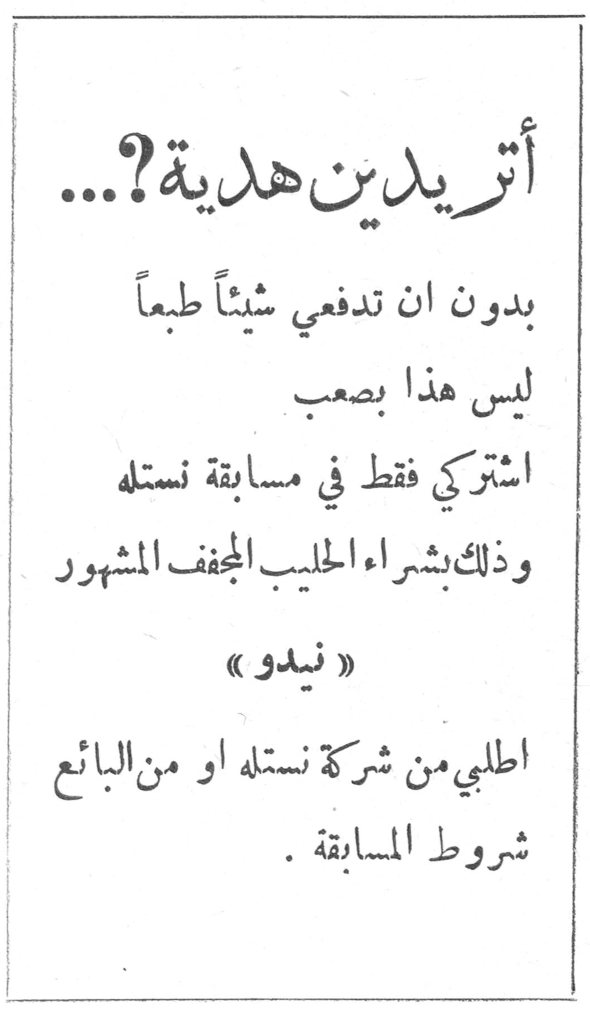
The Nestlé–Nido Contest
Would you like a gift?...
Without paying anything, naturally
That is not difficult
Just take part in the Nestlé contest
by buying the famous powdered milk
"Nido"
Ask the Nestlé company or your dealer for the rules of the contest.