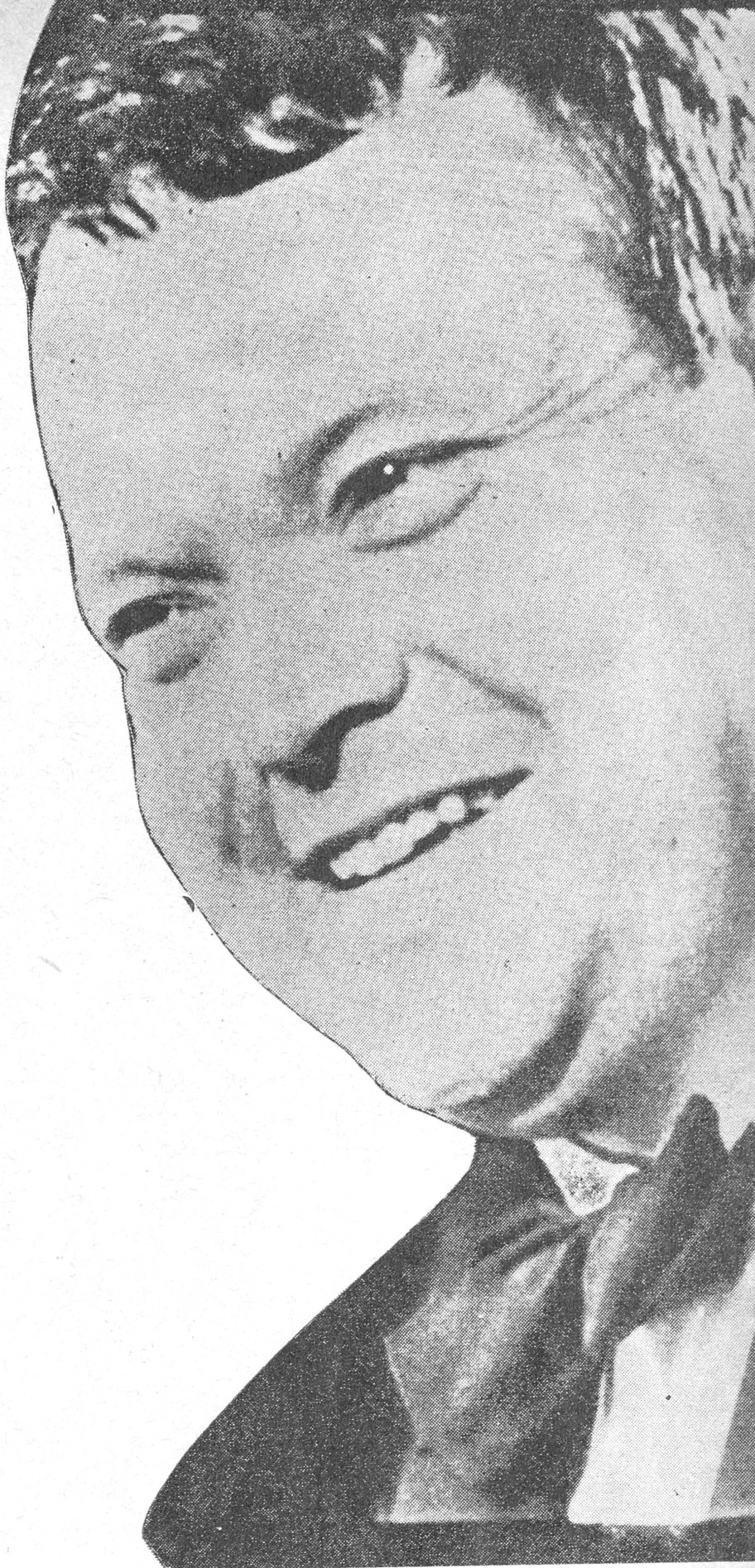
A recent photograph of Orson Welles
The capital of cinema was dazzled by Welles's creative mind and opened its doors to the young genius, and he asked it to give him a full year in which to pass through the doors of its studios as a spectator and observer.
When the year had passed, Welles entered the studio, this time as author, director, and actor; he locked its doors and set to work. A month later he came out, and with him came out the great cinematic masterpiece: "Citizen Kane." The film press received its newborn with a warm welcome, and its critics
could find no word to describe him but one: "genius."
The film "Citizen Kane" changed, and introduced, more than one artistic concept in the seventh art, and proved once more that great art is not confined to the might of machinery and industry, however strong they may be, but is always and forever creation and feeling.
"Citizen Kane" was followed by the film "The Ambersons," in which Welles opened the cinematic field to his friend Joseph Cotten; it was Welles's second cinematic masterpiece. Film followed film, from "The Stranger" to "The Lady from Shanghai," in which the starring role was shared by his wife at the time, Rita Hayworth — that captivating actress who, despite her separation from Welles, has remained a friend to him, respecting him and prizing his genius.
And when the producers' commercial fingers began reaching toward Welles's works, he decided to turn his back and depart...
He departed for Europe, and every city he stopped in — its men of letters and its artists — gave him a reception befitting his lofty artistic production; and at that time he had not yet passed his thirtieth year. Welles kept finding admiring friends he had never seen before, in whom esteem for him had reached its full measure.
At last Welles has returned to Hollywood, after deserting it for twelve years! He had deserted America — that giant young artist who had stood the whole of it on end and made it live on its nerves for an entire night, when he was working in the field of radio and presented his famous program "The People of
Mars," so that overnight his name was on every lip from one end of the country to the other.
Welles deserted Hollywood after making it come to him while he stood on the boards of one of the "Broadway" theaters, directing and acting — his skin dyed black — Shakespeare's immortal play "Hamlet," with a cast all of Negroes.
In the cinema he had new flights that carried the young seventh art broad strides forward. And achieving that was not easy, for if the artistic means were at his disposal, the material means were not; so Welles took to working on other men's account, in films