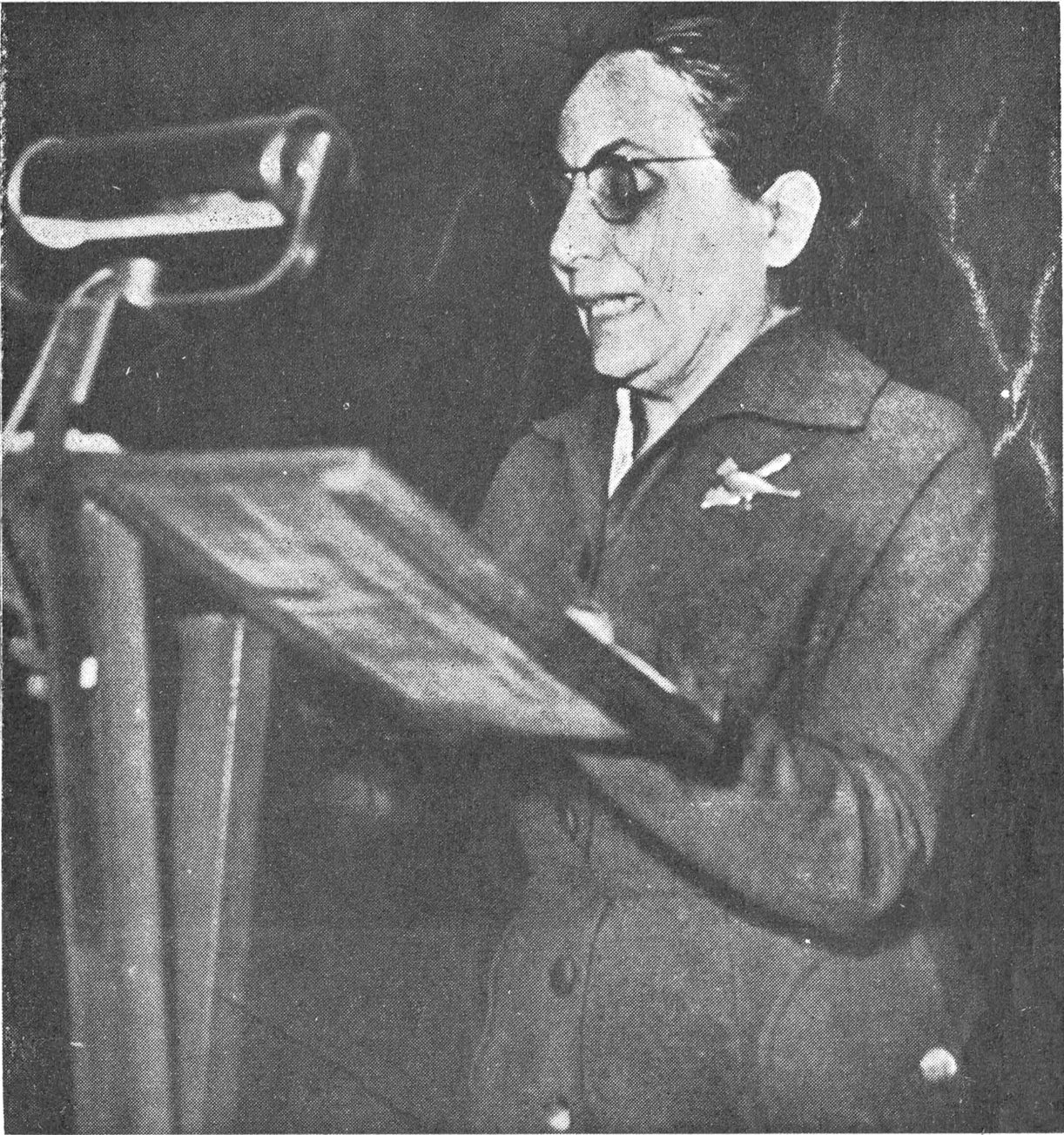
Mr. Michel Asmar knows, when he approaches the lecturers of the "Cénacle" at the opening of each season, how to entrust each lecturer with a subject that belongs to him and is his own specialty. And he chose most happily when he selected the great educator Mrs. Widad Cortas to lecture on "Our Lebanese Girl" — for who is better fitted than the directress of the Ahliah National College for girls over the past quarter century to analyze this subject in a precise, scientific manner joined to personal observation and experience!
The lecturer took up the gravity of the role entrusted to the girl in her near future. She showed
the girl's importance, since it is on her that we must rely for the creation of a generation; then she asked why most of us pay her no attention. Why do we remain divided between those who would give her freedom and those who withhold it from her?
And when Mrs. Cortas speaks of the girl, she speaks with candor and conviction, for she is an able educator and a mother besides, and her understanding of the subject therefore reaches deep into the recesses of the soul. The girl, in her view, differs according to her surroundings and according to her class. Here in Lebanon we have four classes of girls: the rich, at 10%; the middle, at 45%; the laboring, at 25%; and the destitute poor, at 20%.
She spoke at length of the girl's share of culture, whose history goes back a hundred years; the girl
is still earnest in her pursuit of learning, devoting herself to specialization wherever she can. She divided the girl's specialization into two kinds: vocational specialization, such as sewing, embroidery, drawing, and music, and university specialization, such as medicine, law, and engineering. She said that the Lebanese girl has left no field of work unentered, and has excelled in every one — even diplomatic posts, public administration, radio, the press, and publishing. And most of this activity has come at the hands of the middle class of girls, not the rich.
The lecturer could not but knock at the door of marriage and enumerate the problems standing in the way of its ideal form, namely: the problem of marriage between the different confessions, the problem of making wealth the servant of marriage, and the problem of immature marriage; and she showed the complexes and the evils that result from each of them.
Mrs. Widad Cortas placed her hope in the rise of a new generation of girls who will bring renewal and revive the role that the cultivated girl played in the past, and she called for the necessary reform of the teaching curricula, which neither meet the girl's needs nor prepare her for the level hoped for.
Culture is not a fruit to be plucked; rather it is a ladder we climb rung by rung, to pick the delicious fruits from the tree of knowledge.