
of letters, such as Princess Fatima Ismail, the leader Huda Shaarawi, and the writer "Mayy," whose salon was packed every Tuesday evening with the elite of Egypt's men of thought... But Mariana Marrash's merit lies in her having been the first to this innovation, daring to receive men of letters in an age dominated by rigid traditions — a boldness nourished by her travel to France and her acquaintance with the manifestations of modern civilization and culture and with the development of the intellectual and literary movement. Thus she joined her native gifts to a broad knowledge in which the keenness and warmth of the Eastern mind mingled with the learning and freedom of the Western.
* * *
If we may call Aisha al-Taymuriyya the poetess of Egypt and Warda al-Yaziji the poetess of Lebanon, then Mariana Marrash was the poetess of Syria — the more so since her appearance in that pitch-dark stretch of time made her like a star gleaming in the black of night.
Mariana gathered her poems and verse pieces into a diwan, Bint Fikr, containing poems of praise, of passion, of wisdom, and of elegy. Among her famous poems of the heart:
Lovers find contentment in the decrees of passion — so do not, young man, raise the objections of ignorance. My soul be ransom for my loved ones, though they broke that bond and thought love a passing whim. They dealt unjustly, not fairly, in love, when they forsook the pledge of the faithful one who never broke a pledge. Stop and hear the tale of the lovesick one they slew, who used to claim that death had been decreed. An arrow of a glance struck him; he paid it no heed, and died in love of them, never reaching his goal. He saw, then loved, then sought union, and they refused; yet he wished for no substitute for them, and no recompense. His heart was worn to shreds waiting upon a "perhaps"; he slept in patience, and waking exhausted him, and he died.
* * *
Her love poetry, as you see, bespeaks a deep and burning sensibility; and she has wisdom poetry as well, showing that she lived life's experiences with an enlightened mind and a discerning heart. For example, she says:
A young man's honor is a mind by which he rises above all creation and attains the furthest goals of desire. And a man whose deeds bear witness to his virtue and refinement earns praise. Not all who seek honor attain it: whoever aims to hunt the gazelle, hardship befalls him. The man of wealth — his renown departs with his wealth; but the renown of the virtuous never perishes.
And her elegy for her brother Francis, the physician-poet, is no less heart-rent and sorrowful than al-Khansa's verse in mourning her brother Sakhr; we content ourselves with these two lines:
Why do I see the eyes of the flowers wilted, and the bough of their youth bowed in the treetops? Why do I see the garden grief-stricken and in anguish, the water moaning, the air in gloom?
* * *
Nor did Mariana confine herself, among the arts of letters, to the composing of poetry; she went beyond it to journalism. Viscount de Tarrazi says in his book The History of the Arab Press that she was the first Syrian woman of letters to write in the press: in 1870 she published several articles in the magazine al-Jinan and in the newspaper Lisan al-Hal, and in other Beirut papers and magazines. In one of her articles, entitled
"The Madness of the Pen," she complains of the decline of writers and urges the improvement of composition and variety in subject matter.
Mariana Marrash lived in an atmosphere of music and letters; she lived among writers, poets, and men of art, for she found comfort in their company and in the breaths of poetry and music. And although she married and was blessed with children — and thus did not live in sexual repression, as "Mayy" did — she perished of the same stubborn disease that carried off the greatest woman of Arab letters. That was in 1919, when Mariana was nearing seventy years of age and had won literary and social glory, and a place in the hearts of the men of letters and thought which the women of her age envied her.
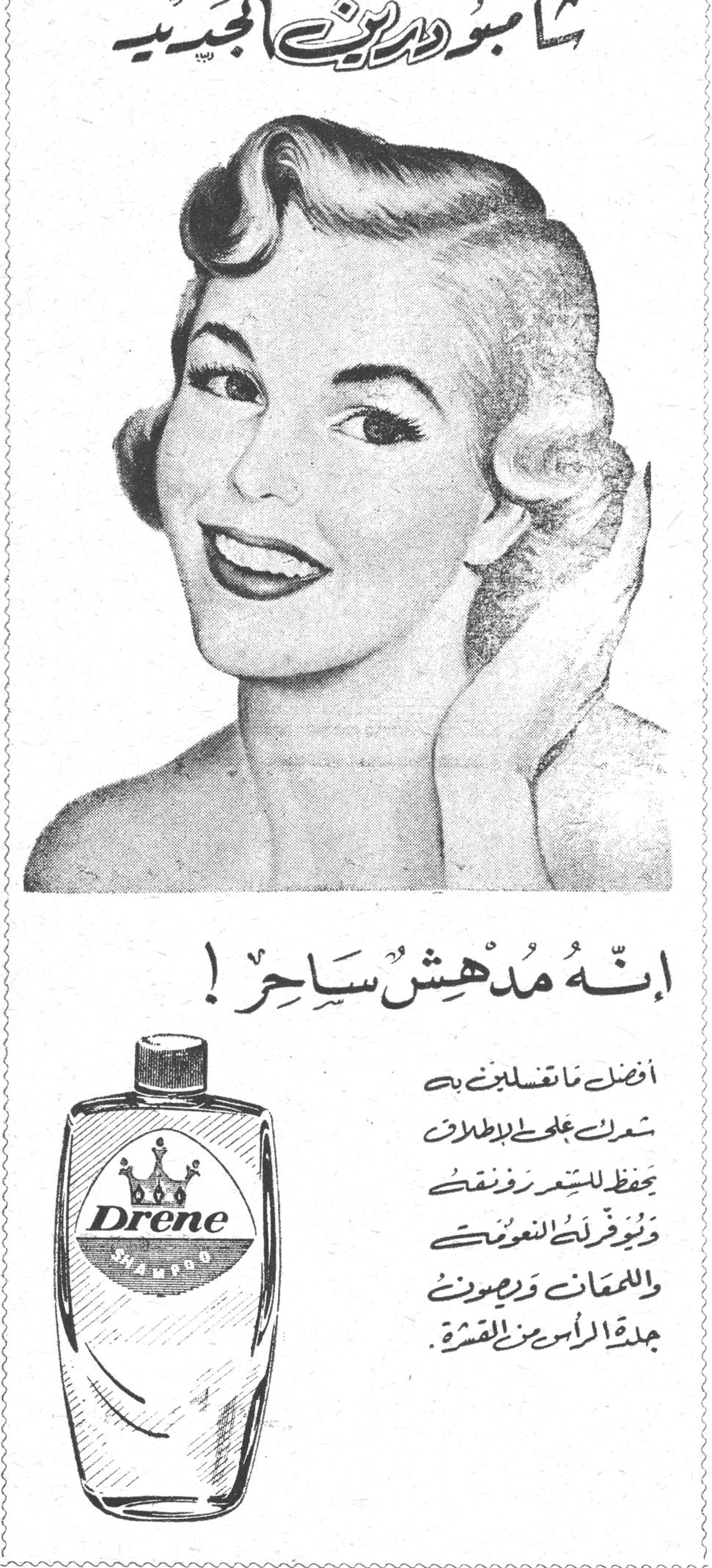
The New Drene Shampoo
It is amazing — enchanting!
Drene SHAMPOO
The very best thing with which to wash your hair.
It preserves the hair's sheen,
gives you wave
and luster, and protects
the scalp from dandruff.