
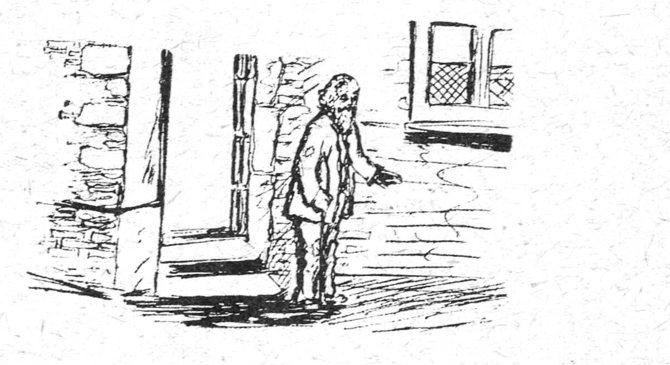
From my office window I would see him every morning coming along in a hurry, and when he reached the beggar posted near the office, he would sigh before the hajj of a beggar and, with a nervous gesture, pull out a small coin and toss it into his hand, then hurry off on his way to the office.
Every morning that I saw him, it seemed to me that he never gave without a small battle flaring up inside him, one that fell silent only when the coin left his pocket for the poor man's hand.
Why, then, does he give? What motives stand behind this giving of his? Love of good? Pity? Habit?
I always found myself disinclined to trace his charity back to any of these three motives.
What can the matter be?
And I would set about trying to analyze the small battle within him.
It is as if our friend, good-hearted by nature, feels whenever he reaches the poor man that with his charity or his compassion he is solving no problem, and changing nothing of the beggar's condition—for changing his condition depends on social designs beyond his power—and that by his almsgiving he is doing no more than silencing an importunate voice.
And from his sense that he is doing nothing of value, the small battle flares within him.
One question remains.
Who imposes the giving upon him?
Something in his soul called conscience, and a trace of an upbringing that taught him that a good deed wards off many calamities...
Our friend, in his modest giving, is not reassured that he has done anything; but he is buying the silence of this conscience that lives in him.
And perhaps too—without knowing it—he does not want to gamble with the hereafter.
With the rise of the national movements in the Arab countries, anthems sprang up in our lands singing the love of the homeland and parading its many glories.
From that day to this we still hear these anthems, which have worn themselves out and lost their expressive character and the power to awaken any feeling in singer and listener alike. Besides, singing the love of the homeland need not always be done by melodized shouting.
In the whispered song there is a power to awaken emotions and stir sorrows.
And the song that carries an idea is undoubtedly higher in its capacities than a song that lets loose words defining no meaning at all.
The conscious national song never disdains to sing of the green of the earth, of a white flock grazing in a pasture, of an enamored palm tree beside a dreaming river, of a wild flower straining upward from between two rocks.
Who among us has not felt that his cause, in "Raji'un," was presented in a human form that raises it to the level of tragedy? And who among us has not been moved, feeling himself the child of a great story, as he listens to the voice of Fairuz singing:
My country—return me to it, though it be as a flower, O Spring
When he proposed to her he told her, at length, of his Don Juan adventures, and did not scruple to bring out a heap of pictures of blondes and brunettes of every kind and age...
He sighed with satisfaction, like a man proud of being experienced and of having lived a full life before growing tired and settling down to one woman on whom to cast the remnants of his life. Then he raised his eyebrows at her and said: And you?
She smiled wearily and said: I am an Eastern woman; my history begins from the moment you knew me...
He refused to believe it... His experience had taught him