that behind reserve lie folded pages which he felt it his right, as her betrothed, to unseal.
She kept to her silence and he kept to his insistence.
And when she wearied of his persistence she told him, with pain in her eyes, of a first experience of love.
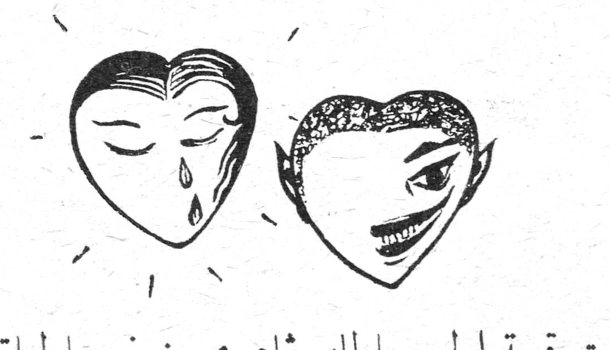
She let herself be carried along by the warm memories, and her tongue forgot to be guarded.
She brought out the love story in a poetic frame throbbing with life.
And when she had finished there were two tears in her eyes...
He left her in anger, slamming the door behind him...
Poor girl—she forgot that she had wounded an Eastern man's egoism to the quick, merely because she was truthful?
A sight shook me a few days ago and set me before two stances toward one and the same tragedy.
A positive stance that overcomes, with the stubbornness of one who loves life, everything that mars the beauty of this life.
And another that reflects the weakness of defeatism and surrender to circumstance, with the passivity of one who dares not resist the stronger hand.
The sight pinned me to my place, staring at it while its two parties sensed nothing of me. I saw a blind
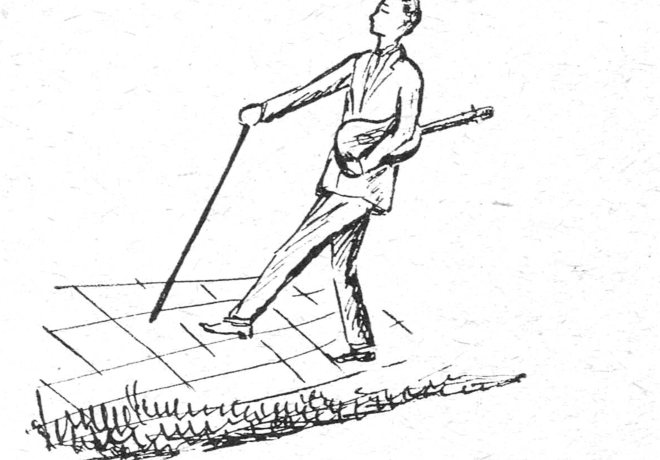
man walking with a musical instrument under one arm and a cane in the other hand pass by a blind man begging; he pulled out a coin and dropped it into his hand with compassion, then walked on in pride, the tap of his cane on the ground telling the tale of a small heroism—yet one greater than fate.
He was one of those whose hopes go roaming beyond the patch of this country, for the legends had bestowed on him a land whose very dust is of gold and diamonds—on the authority of the moving pictures—and he grew up with his eyes fastened on
one of the lands of emigration.
He made everything ready: he resigned from his post, wound up his affairs, bade farewell to his family and friends, packed his bags, and clutched his passport tight.
A few days before he was to travel, chance allowed him to meet one of those returning from over there—a man at the gates of old age, come to renew his acquaintance with this world and its people.
He was rich; he had paid his life as the price of the textile works he owns in Brazil, and he came back to his homeland bearing the privation of forty years spent toiling there.
The first thing he did when the airplane set him down was to kiss a handful of his country's soil; he would gladly have kissed every face in its airport.
He went about searching for his past, but its landmarks had grown confused to him.
He found that his mother had died waiting, and his brothers had married, so that among them he seemed like a stranger.
His old house had been torn down, and in its place rose a building that he resented for wiping away the memories of his childhood.
He had lost his whole store of human affections, and nothing was left him but a factory in Brazil.
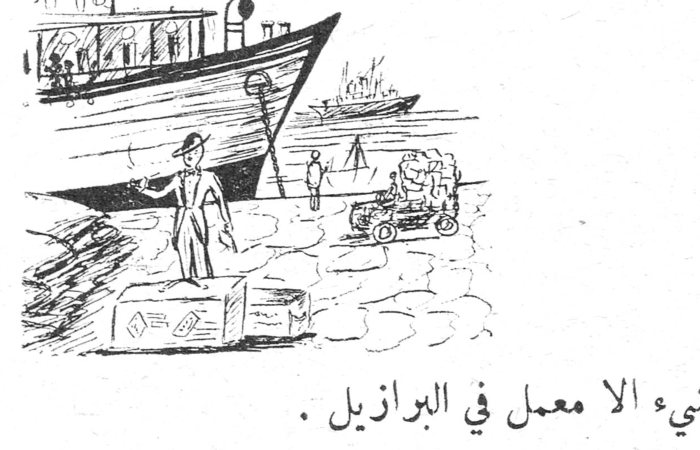
He had lived there knowing nothing but toil and misery, and society never opened its breast to him, for he was a strange ewe among the flock...
He went on living on the hope of return—on the dream of an evening among friends, colored by the tremors of a tender oud—and lo, disappointment was his whole harvest.
He sat telling the young man, his eyes brimming with tears.
Telling him of the dryness of the long nights whose loneliness no Arabic tongue was there to cheer.
He told him of the sense of being lost that wraps the emigrant, however high his balance at the bank may rise.
He told him of eyes wet with tears before an Arabic record in which nothing of the singer's voice remained but the scratching.
The old man wiped away a tear and said: My son, I would sell my fortune to live life over again, in my own country.
The young man listened in silence—and to this hour he is still torn between the old man's counsels and his suitcases, which wait.