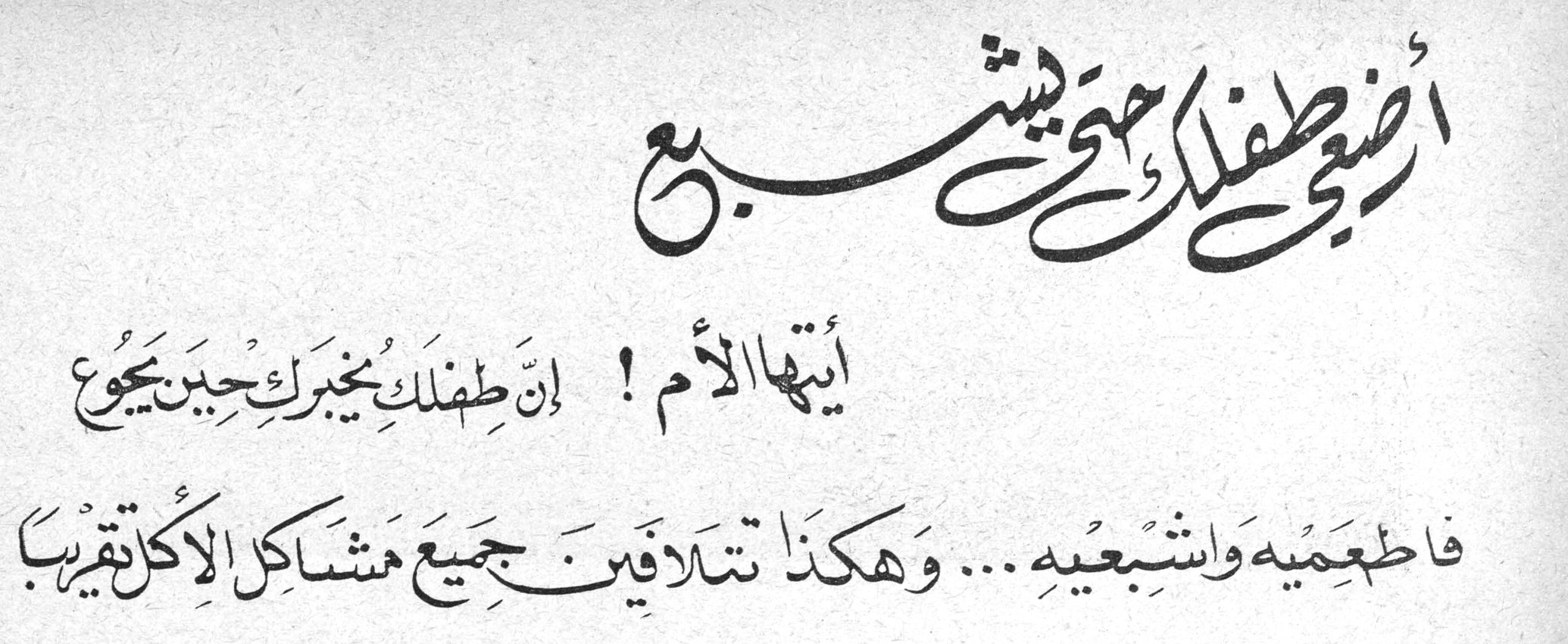
Mother! Your child tells you when he is hungry
So feed him and fill him... and thus you will avoid nearly all feeding problems
You will be surprised how many of the things that trouble infants come from their not being filled during feeding — how many mothers commit such an error without meaning to. Here is the doctor's explanation for making sure your baby has had his fill.
One morning we went to the newborn clinic at one of Beirut's hospitals and saw five infants whose mothers had brought them in, anxious about them. One infant had diarrhea while another was vomiting; the third suffered from colic while the fourth was losing weight despite an increase in the number of his feedings; and the last was not getting enough sleep.
Although the condition of each of these five infants differed from that of the others, the treatment prescribed for them all came down to the necessity of feeding them enough.
We do not mean by this that every mother who finds her child suffering from one of the conditions mentioned should diagnose his illness herself, decide that he is not getting enough nourishment, and neglect to call the doctor. There is the possibility of an important cause behind each of these symptoms.
As for our saying that the child needs to eat more, it does not mean stuffing him more and more. There are reasons for his not eating the quantity he ought to take while remaining comfortable. The child should sit during his feeding in a nearly upright position that allows the milk to drive the air out of his stomach and take its place.
The bottle should be held in such a way that the nipple stays filled with milk, leaving no empty space for air to fill. And when the baby's feeding time comes, we must not let him wait long, so that he does not cry long — for crying fills his stomach with air, and it also exhausts him to the point where he can no longer eat as he should.
In addition, the holes of the bottle's nipple must not be so small that the child is forced to draw the milk with difficulty, so that he tires and falls asleep before he is completely full. If the baby takes twenty or thirty minutes to drink his bottle, there must be a cause to be sought out and remedied — and often the nipple of the bottle must be widened.
These are some of the things to watch, instead of deciding to cut down the food when the signs suggest that the baby has had enough — when that is not true. Let us return to one of the infants we mentioned at the beginning of the article. When his mother was asked about him, she answered that his stool was loose, frequent, and green in color. So she thought the baby's feedings must be reduced, on the pretext that "his bowels must be rested."
We do not deny that reducing the food and feeding the child special kinds of food is a suitable treatment for many cases of diarrhea. But our study of such cases refuted this conclusion. The child's case can be summed up as follows:
A child's digestive organs ordinarily do extra work after a meal. If the meals are small and frequent — as is the case