
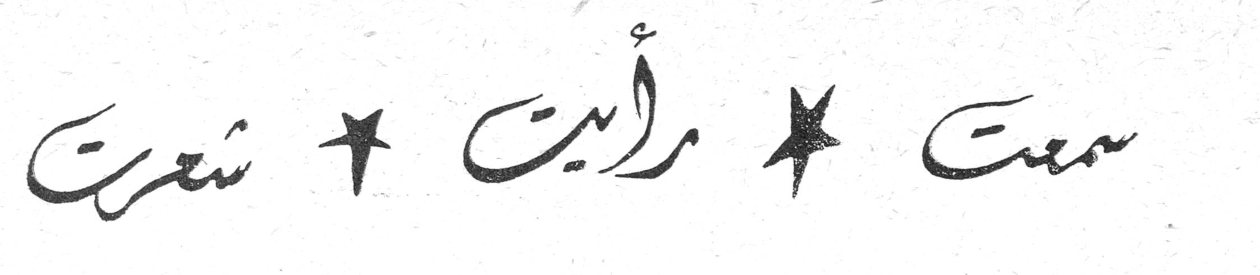
* I Felt
Here... in this narrow, crowded street, the shops spread along both sides, and the vendors' boxes and display stands take up two-thirds of the road in the most annoying fashion. The shoppers jostle one another, passing and stopping, like a column of ants busily carrying grain to their nests. I stood listening to the lack of taste and the absence of courtesy... Here is a vendor addressing a lady who has cast a passing glance at his shopfront: "Come in, madame... this way... welcome, most welcome." And no sooner does the lady walk on, paying no heed... than the voice of the "well-mannered" vendor rises: "What's this... you won't answer us? Who do you think you are? We've seen plenty like you..." And he guffaws "with an Abyssinian swagger"...
...A little modesty, good people... Shoppers come down to the market to buy what they choose for themselves and what suits their own tastes, not your deficient "tastes"... And it is not to be expected of every lady that she answer your cheap, tiresome compliments and words of welcome...
An aristocratic lady hires a small porter with his big basket, takes him around some of the vegetable shops, and buys her needs to the value of about twenty liras; and the slight young porter moves with his basket from place to place with her... She spends a quarter of an hour and more; then the porter calls a fellow porter to help him hoist the basket onto his back and strap it around his head. He has hardly walked a few steps when the aristocratic lady turns to him and says: "Stop... take this," and hands him ten piasters... yes, ten piasters.
Here the porter protests, imploringly... and the lady grows angry, waving her hand: "So you want more than ten piasters? Why — what has the world come to? Your trip is a short one... it's right here..." And the porter walks on, sighs of pain under his heavy load coming one after another with his breath. This inhuman conduct stirs my anger, and I follow the porter to where the lady pointed — and find myself before a splendid automobile that testifies to the standing and wealth of this "humane" lady. The porter calls on some passersby to help him lower the load from his back, and begins transferring the purchases from his basket to the trunk of the car, while the lady stands watching the operation and issuing her instructions to the wretched porter: "Mind you don't put the tomatoes on top... set down the bag of apples... mind the eggs don't break... blindness take your heart, don't you understand... take it slowly...!" All this goes on while the chauffeur sits
behind the wheel without stirring a finger... The car went off on its way once the lady had taken her seat in it. And the porter went trotting back, humbled, toward the vegetable market, dragging his basket and his ropes behind him...
My good lady: do not economize on the porter's wage... It is enough that fate has cast down this poor boy, whose frame has not yet hardened, to carry loads on his back and earn his crust of bread... What harm would it do you to pay him his wage twice over?.. Save those miserable piasters, my lady, out of those costly silks... out of your jewelry... out of your diamonds and your luxuries... and give generously, without grumbling, to these porters and bootblacks and street-sweepers and their like. If you do that, you rescue them from misery, and so they come to feel the worth of life — and no way is left for the deceivers and the wreckers to use them and dupe them!
I entered a jeweler's shop to buy a gift for a newborn child, and while I was sitting, examining and choosing, a dignified lady entered the shop and showed the jeweler a simple diamond ring she wanted to sell him. After the jeweler had made the necessary examinations of the ring, he offered a paltry sum as the price of the ring, diamond and all. The lady objected, saying: "How can you expect me to sell my ring for 500 liras, when my late husband bought it for me for one thousand five hundred liras?.." At this the jeweler rose from his place, summoned one of his employees, and asked him to go off with the ring and have its price estimated by showing it around the neighboring jewelers' shops... There were movements and signs and whisperings between the jeweler and the employee. A little later the employee came back saying: "One offered 500, the second 400, and the third 450... and everyone who saw it said the ring is worth no more than 600 liras, from which the cost of the workmanship must be deducted, bringing the sum to 500 at most... and that is an estimate of value, not an offer to buy."
I sensed that the dignified lady was a recently bereaved widow, in some measure of despair, sorrow, and want, ashamed to carry a ring around and make the rounds of the jewelers from one shop to another... And I sensed too that the jeweler, that man of little fairness, had succeeded in his maneuvers and in deceiving this poor widow... for she was persuaded, and accepted the price offered. I reproached the jeweler sharply for this conduct, and he answered me: "It's a livelihood... everyone looks after his own living. There are women we sell topaz to at its weight in gold. What is it to you? That's my trade!"