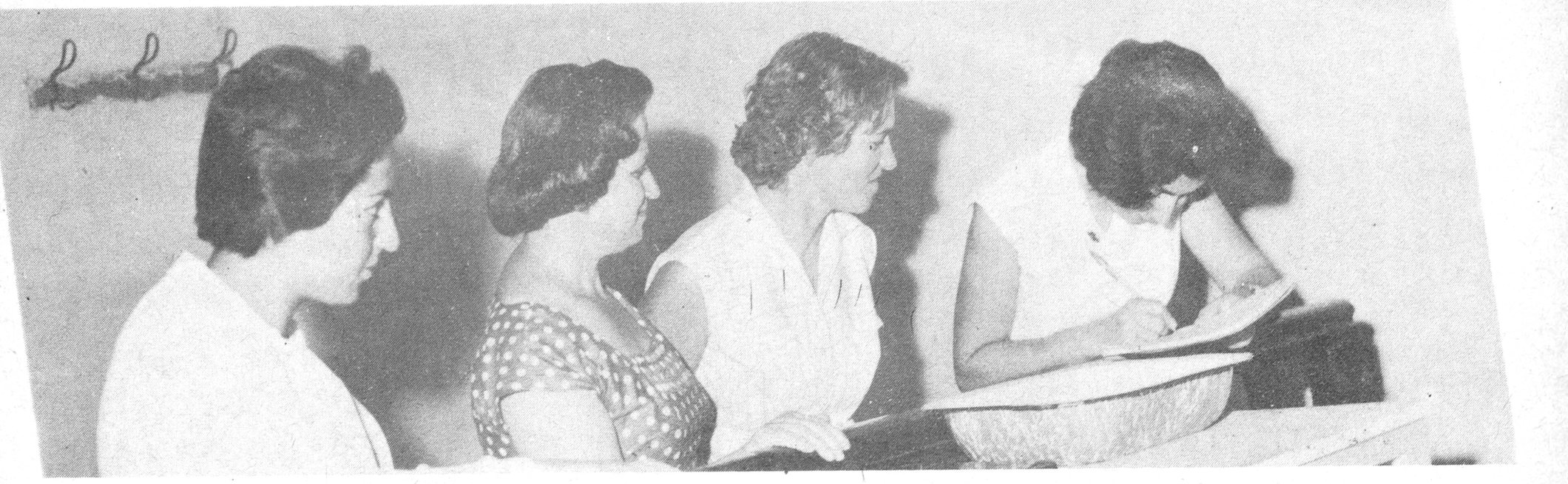

Three women volunteers registering their names and addresses
In the distant past, certain death was the fate of anyone who suffered the loss of a great quantity of his blood as the result of a grave wound or a violent accident. Then medicine discovered the possibility of saving the bleeding man from death by supplying him with living blood, carried into his vein from the vein of a healthy person; and this discovery scored a great victory in the humanitarian, vital, and health fields, and from it sprang a special science whose serious results and benefits have shown themselves clearly, above all in mass calamities such as wars and natural disasters.
Scientists persevered in their researches and studies, and before long important truths and secrets were revealed to them — among them the possibility of preserving blood outside the human body without its losing its living natural properties, and of storing it up in varying quantities just as money is stored up in banks. Thus its usefulness spread wide at the time of "transfusion operations," and blood came to be kept in laboratories, each one of which was called a "blood bank." From that day on, human blood has had its material value, bought and sold like drugs and milk...
But the wars and the national and natural catastrophes that mow down hundreds and thousands of innocents alerted humanitarian and medical institutions in every part of the world to the importance of storing blood after collecting it through appeals for free volunteering, to which people of charity and great merciful hearts respond. Foremost among such institutions known to us are the Red Cross and Red Crescent societies of the world.
The Lebanese Red Cross, for all its limited means, has a distinguished record of activity in this field. It has had the honor of contributing effectively to the saving of hundreds of lives — first during the Palestine war, then during the natural disasters that struck Lebanon one after another these past three years... These experiences served as a school, from which the members of the Red Cross set out into
deeper humanitarian experience and more fruitful giving. And now, at last, in these bloody disturbances that Lebanon is suffering today, the importance of the "blood bank" and the noble humanitarian services it renders on the purely human plane have come to the fore. We therefore thought it useful to speak here to our readers about this absorbing subject.
Because the humanitarian mission of the Red Cross embraces all, its units are welcomed in Lebanon today by all groups and communities, whatever their political leanings and tendencies. Every barrier collapses at once before the siren of the rescue car — a car white as the dove of peace, which pushes into all areas, open and forbidden alike, to provide the necessary first aid and answer the call of the needy — every needy person — whether near at hand in the city or far off on the mountain heights or in the farthest reaches of the North or the South.
I congratulated the members of the Lebanese Red Cross on the orderly plan they are following these days under the direction of its president the Marquise de Freige and the vice-president Mrs. Fayza al-Solh, and on the energy of the board of directors, among whose members are the ladies: Alexandra Issa el-Khoury, Laure Tabet, Najla Saab, Rose Kettaneh, Sumayya al-Khazen, Afifi Majdalani, Heneni Tarcha, Ellen Rihan, Marcelle Hochar, Eva Serhal, Renée Arman, and others.