
Salwa Dimashqiyah al-Said talks about the third conference of the "Committee of Correspondence" in Washington
The Committee of Correspondence — Talk with our friend Salwa al-Said is always delightful and rich in feeling; is she not the daughter of the most polished woman talker Lebanon ever reared — I mean Julia Tu'mah Dimashqiyah, God rest her soul.
We had had it in mind to talk with Salwa about the Baalbek festivals, the new decisions, and the surprises awaited this summer, since she is an active member of the responsible committee; but the bloody events that have swept Lebanon these past two months strangled the plans in their cradle and bolted the door against anyone who had promised himself a rich feast, tourist and Lebanese alike.
But there was another matter to talk over with Salwa, just back from New York, where she was invited to represent Lebanon at the third international conference of the Committee of Correspondence.
For acquaintance and the exchange of views
The "Committee of Correspondence" was founded in New York five years ago by fifteen ladies who belong to international women's institutions and preside over the finest public and private societies in New York. The striking trait they all share is energy, and a sincere love of knowledge — and hence of growth.
The aim of the "Committee of Correspondence" is the exchange of information and views on the basic problems that concern
woman in every part of the world. Long experience has proved to them that nothing serves their aim and leads them to this goal like personal contact, through inviting delegates from all over the world to widen the circles of acquaintance and to draw information and news from its very sources, undistorted by crooked propaganda.
America knows nothing of the outside world
The American woman admits, frankly and good-naturedly, that she knows little of the events taking place in the world that concern her and affect her society; but she does not conceal her pressing eagerness to know the bare facts and to look upon the plain truth — as though she had grown suspicious of the Zionist propaganda which has spread and struck deep, and whose influence has overrun the American press.
The problems of woman in the Middle East
Hence the meeting of the "Committee of Correspondence" this year was devoted to the problems of woman in the Middle East. It was held between April 25 and May 19 last, and was attended by fifteen ladies representing eleven countries: Iraq, Egypt, Syria, Lebanon, Jordan, Saudi Arabia, Tunisia, Morocco, the Sudan, Turkey, and Iran.
Fifteen ladies of heavy caliber, in culture and in social standing, joined together by "Arabic" — all but two, and no more: the delegates of Turkey and Iran. So it was no wonder that they agreed from the outset on the various problems woman suffers in the Arab countries — social, cultural, and political — and then tried to find practical
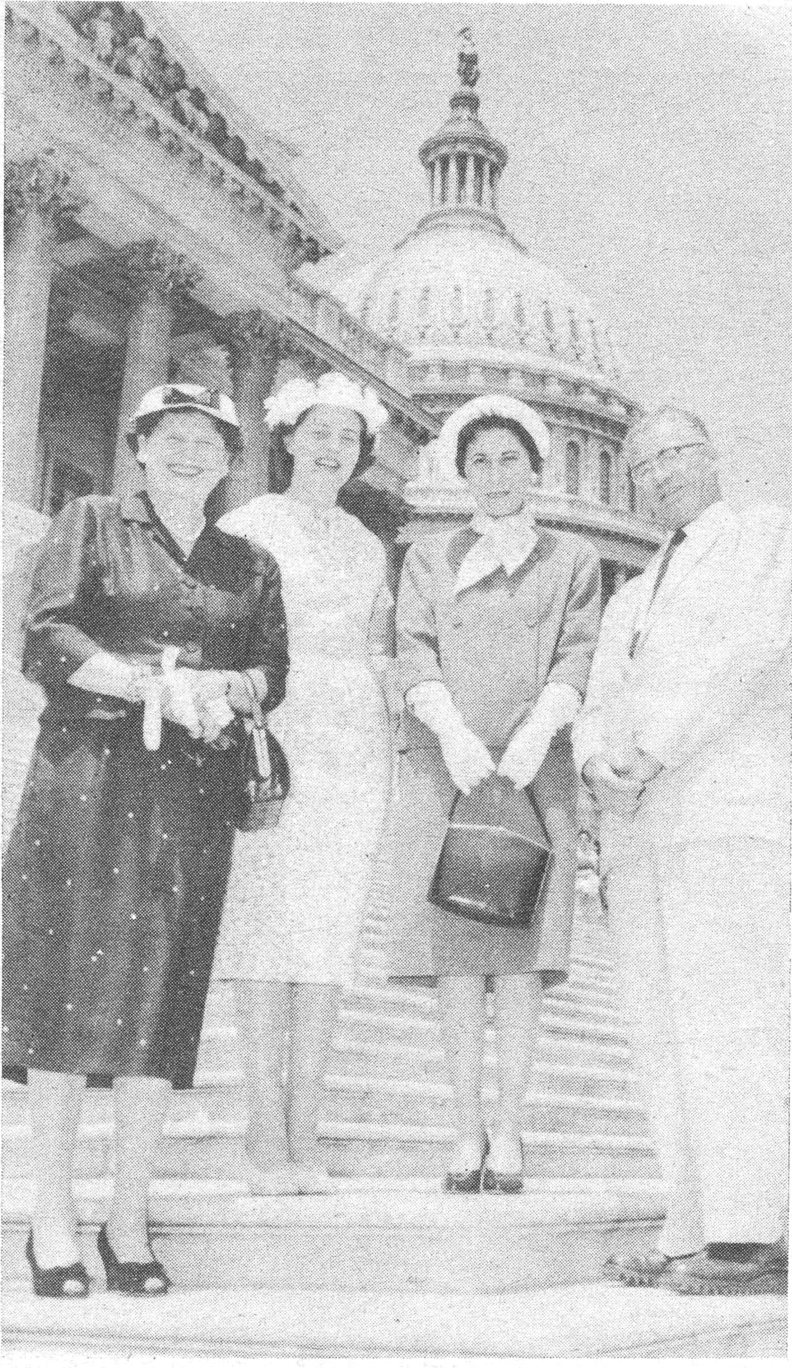
Salwa with Margaret, wife of her brother Nadim Dimashqiyah, our ambassador in Washington, together with Mrs. Horan and her husband, a member of the American Congress
solutions for spreading peace and security, with all a woman's ardor and sincerity.
The Arab delegates: Among the delegates appeared Arab faces that have shone in their societies and whose voices have risen in the fields of social service and the liberal professions. Besides Mrs. Salwa al-Said and Mrs. Najla Estephan (Lebanon), there were Dr. Lam'an Zaki al-Damluji and Ghuzin Rashid (Iraq), Zahia Marzouk and Lily
Doss (Egypt), Atifa al-Jabiri (Syria), Madiha Nusseibeh (Jordan), Naila Ben Ammar (Tunisia), Leila Ben Allal