
Madam:
You are at home, or at your neighbor's, and an accident befalls you or one of the members of your family or your neighbors... How do you act in the face of the accident? When may you decide the matter yourself, and when must the doctor be called?
The Woman's Voice, here, makes this clear for you...
1 — Shock: The first thing to attend to is the "shock" that accompanies an accident, whether violent or slight. The signs of "shock" are pallor of the face, a rapid pulse, and dryness of the mouth.
Lay the injured person out flat on his back without a pillow under his head, cover his body with a cotton blanket, and help him drink a hot cup of tea or coffee — unless he has lost consciousness. And beware of showing your agitation and fear before the injured person; be brave in every case.
2 — Bruises: Place compresses of ice or cold water on the bruise, and secure rest and stillness for the injured limb.
3 — Burns: Slight burns that raise no blisters on the skin we treat with cold water, then by wiping them with castor
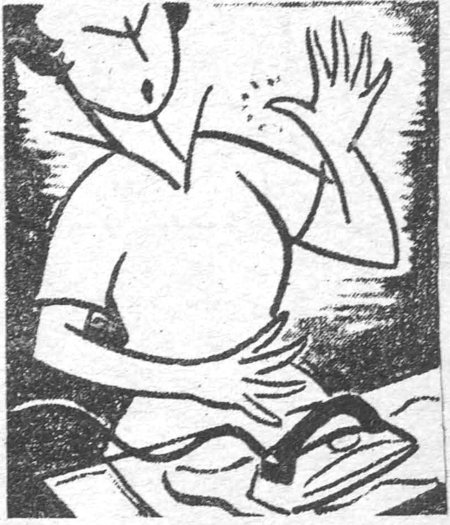
oil or olive oil. There are also ready-made remedies made specially for burns, and every housewife should keep a tube of them on hand for need.
4 — Sprains: If your ankle turns while walking fast or off balance, make
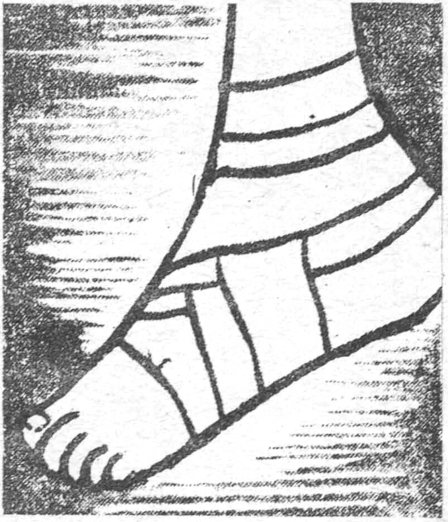
sure first that the bones are sound and the joints in their places; then wrap the foot in a bandage wetted with water and firmly fixed. Keep the foot at rest, and wet the bandage with water whenever it dries; and to ease the pain, give the injured person a sedative such as Aspro.
5 — Bee or wasp stings: For a bee sting, lessen
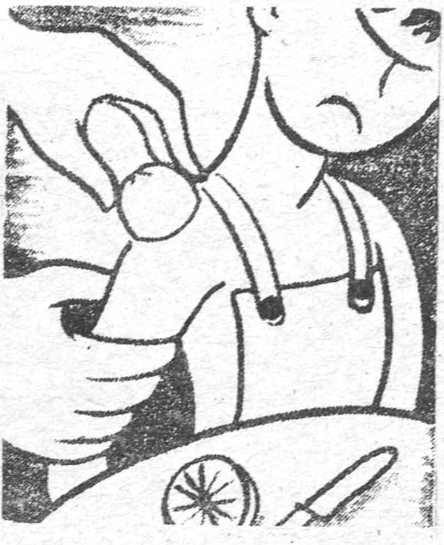
the effect of the poison by putting a solution of ammonia or salt water over the place of the sting; for a wasp sting, blunt the sharpness of the poison with a piece of something acid on the injured spot. To remove the stinger, if it remains embedded
under the skin, take help from the back of a knife after sterilizing it. Use it gently, and without hurting the injured person.
6 — Poisoning by charcoal gas or the like: To aid one who has fainted from
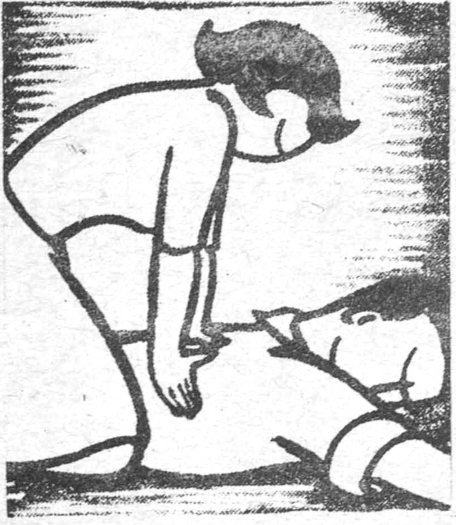
inhaling charcoal gas or the like, carry him into the fresh air and keep him warm while artificial respiration is carried out, as shown in the drawing. Call the doctor.
7 — Poisoning by medicines: If you suspect that your child has swal
lowed some medicines, do not be slack in calling the doctor or carrying him to the hospital at once, for the effect of most medicines does not show
itself quickly. Give the patient a large draught of water to weaken the effect; and if the medicine is of the "sleeping-pill" kind, two teaspoons of salt in a glass of water help greatly. Do not let the patient give in to sleep — by means of drinking tea and coffee.
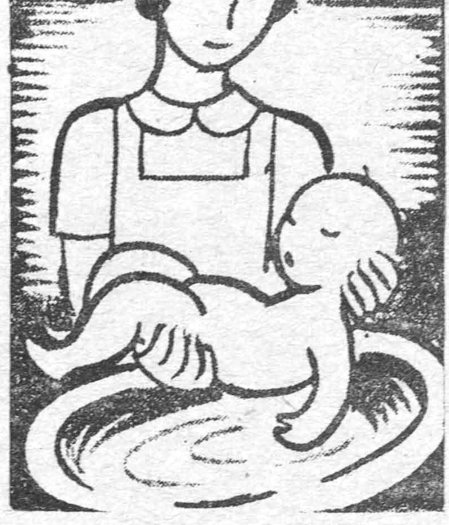
8 — Fits of convulsion and trembling: Their cause in children is a rise of temperature, and they are more mild than dangerous. Strip the child, place him in a bath of hot water, and put compresses of cold water on his head. It is well also to wash out his insides with an enema of lukewarm water with a little oil. When necessary, call the doctor.
9 — Bleeding from the nose: To stop the blood, let the patient lie back on his back without a pillow, with the head thrown backward. Place compresses of cold water on the back of his neck and head and on the top of the nose. And let the patient try, as far as possible, to breathe through his mouth and not to blow through his nose.
10 — Fainting: Lay the fainted person out on his back, loosen whatever clothing may be pressing on his chest, sprinkle his face and hands with cold water, give him stimulating scents to inhale, and open the windows until the doctor arrives.